Monday, 1 July 2019

Barnet Council Plan to Gag Residents

Last week the Constitution and General Purposes Committee proposed significant changes to the public participation rules. Currently, up to 30 minutes is set aside at the start of each committee meeting for public comments and questions. You have to submit the questions by 10am 3 working days in advance of the committee meeting and you also have to specify which agenda item on which you wish to make a public comment.  At the meeting the resident gets 3 minutes to make their public comment and they can then be questioned by committee members. Questions are taken in strict rotation so everyone who has asked a question gets a chance to ask a supplementary question. Even if the questioners do not get the chance to ask a supplementary question there is a written response to their original question. This provides a useful audit trail when matters arise in the future.

Last week all those rules were changed.  Following ratification at the forthcoming full council meeting on 30 July public participation will be dramatically reduced. The Council's proposals are as follows:

Questions and comments should be amalgamated. The number of words for each question/comment should be limited at 100 and must be submitted in writing by 10am 3 working days in advance of the committee meeting.
Residents may raise one question/comment on an agenda item. The question/comment must relate to the substantive matter to be determined by the committee. No more than two questions from residents will be allowed per agenda item taken in the order of receipt by the Governance Service.
These changes means the public will no longer be able to address the committee in person and councillors will not be able to ask the member of public about their comment. When reports run to many pages, summarising a single question or comment in 100 words will severely restrict what people can say. Residents will only be able to make one comment or one question on an agenda item but if more than two residents ask a question or make a comment on an agenda item, no other questions or comments will be accepted. 
Barnet say this is about saving money and giving more opportunities to residents. It will do neither especially, if residents are forced to submit multiple FOI requests to get important answers. It seems clear that Barnet do not like residents scrutinising decisions such as the Council's £22.9 million loan to Saracens Rugby to build a new stand at their stadium or asking questions about the £2 million fraud carried out by a Capita employee which went undiscovered for more than a year. Capita's performance in areas such as Highways and Pensions Administration have been dismal but public scrutiny of their performance and why they are being allowed to continue to provide such a poor service will now be all but eliminated.
The Council are also making major cuts to services such as libraries and are changing the rules to force disabled people who receive in-home care packages to move into residential care simply because it is cheaper. The ability to question these changes will be dramatically reduced, allowing the council to rubber stamp decisions without any meaningful engagement with the public.
Barnet residents have a right and a need to scrutinise the Council and these changes will eliminate that scrutiny. I admit I do ask quite a few questions but that is simply because I believe committees are failing to provide adequate scrutiny. Conservative councillors keep saying the questions are political. The questions I ask are almost always about money and performance. With £20 million of budget cuts this year and a further £47 million of cuts over the next four years it is important that Councillors at least listen to the concerns of residents.
If you think the Council's proposals are wrong, please sign the petition here or go an visit your local Conservative Councillor before the Council meeting on 30 July. Details of all their councillors' surgeries are on the Barnet Council website but I have summarised them here for your convenience.


Tuesday, 11 June 2019

Capita Contracts Review - My open letter to the Policy & Resources Committee


Response to Review of Capita Contracts
Introduction:
The review set out at Agenda Item 7 falls short of the standards that should be expected when considering such an important decision. As such, any decision taken at this meeting will have no credibility and may expose the Council to the risk of a legal challenge. Worse still, it may fail to address the unsatisfactory performance of Capita and provide poor value for money at a time when budgets are under extreme pressure.
The Council has chosen to withhold Appendix C which contains the business case that support the decisions. Without that Appendix there is no way to validate or support any of the assertions made in the report. I have asked both the Leader and the Chief Executive to release Appendix C but have so far not even had the courtesy of a reply.
There were numerous misstatements and inaccuracies at the time these contracts were originally let. Many of the concerns raised then have come true. Contracts reviews were carried out in years 3 and 4 which found that everything was fine, yet we have been hit with a series of recurring problems which suggest the reviews failed to discover or address the underlying problems.
Starting Point:
In July 2018 this committee resolved the following:
1.   Agrees to review the council’s partnership with Capita, and authorises the Chief Executive to develop a Full Business Case.
 2.  Agrees that the proposed strategic aims underpinning the Full Business Case should be to:
a)    Deliver high quality services; b)   Secure best value for money for Barnet’s residents; and
c)    Strengthen the council’s strategic control of services.
 3.  Notes the three options identified and considered in more detail in paragraphs 2.4 to 2.7 and Tables 1 to 4.
 4. Agrees that option 2 – realigning the CSG and DRS contracts to bring back in house those services listed in Table 5 – is the proposed preferred option to be tested in the Full Business Case.
 5.  Agrees that option 3 is fully tested and considered in the Full Business Case.
 6.  Agrees that the Full Business Case should review the joint venture arrangement for the delivery of Development and Regulatory Services.
 7.  Agrees that the Full Business Case should be considered by Policy & Resources Committee, for referral to Council for final decision.
Eleven months later and this has not been delivered, even though there was both a clear rationale for doing so and unanimous approval by this committee. In the interim, a meeting was held between the Council and Mr John Lewis, the Chief Executive of Capita, but there are no minutes or details of what was discussed or agreed at that meeting nor the extent to which that meeting has influenced the remit and structure of this review. As such, it raises serious concerns about governance and authority of this committee.
 Failing Performance:
Capita’s performance has been lamentable. The fraud and subsequent Grant Thornton review exposed the fundamental failings of Capita’s systems, the inadequacy of management and failure of the Council to adequately monitor Capita’s performance. It was also noticeable that Grant Thornton identified that “the Business Director for Regeneration, with overall responsibility for regeneration projects, had only nine months experience of regeneration and was not directly involved in reviewing the financial management activity of his managers. The role was geared more towards commercial account management, focusing on the contractual relationship with the Council and not with detailed functional and technical oversight of the projects themselves”. The high turnover of senior management is a recurring theme across a number of the failing services provided by Capita.
The Pensions Regulator has fined Barnet and issued improvement notices because of Capita’s failure to provide a basic service. Again, the churn of senior management has exacerbated the resolution of the failings. Schools Payroll has been given a no assurance rating by Internal Audit and 170 members of staff had pension payments incorrectly deducted from their pay packets.
Highways performance is poor in spite of spending £50 million on the Network Recovery Plan. The complex contractual framework, the inability to agree and enforce common KPIs between Barnet and Capita and between Capita and the Highways contractor has made contract monitoring and enforcement much more difficult. Yet again, there have been difficulties in recruiting and retaining a Senior Highways Manager. It is also important to note that Capita were paid an additional £1 million in gainshare on the Highways Contract even though London Councils initiated the contract.
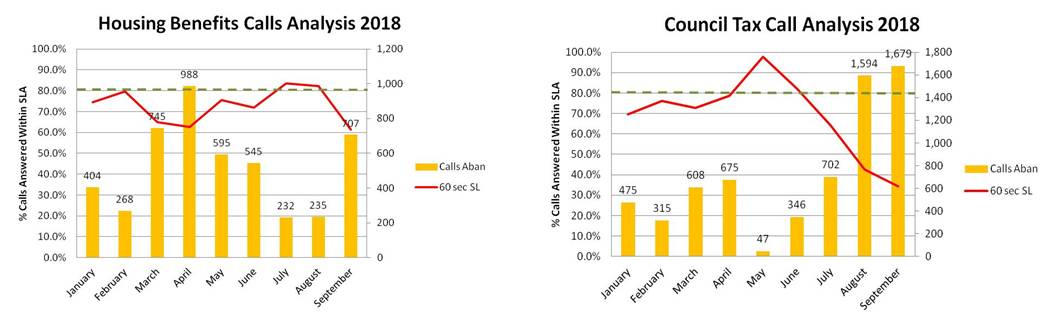
Customer service has failed to meet targets with calls to Housing Benefit and Council Tax, having failed to meet the agreed KPI in any single quarter since the contract started, even though the 20 seconds service level target for answering calls was raised to 60 seconds.

What makes this situation even worse is that Capita claimed an additional charge on top of their core fee because the number of calls answered exceeded the contracted volume.
IT has been a consistent failing service. The implementation of the Mosaic casework system was commissioned from Capita as a special project for which they were paid extra, on top of the contract fee. However, they still failed to deliver the system and new external consultants were commissioned to implement the system incurring additional costs. It has also caused significant operational difficulties and is sufficiently serious to be identified as a red risk on the Corporate Risk Register (AC028).
Procurement has been poor, with Capita being paid £5.9 million in gainshare on procurement contracts even though it appears to be generally realised that the savings were nothing more than smoke and mirrors. This became even more apparent at the Urgency Committee on 30 November 2018 when a settlement was agreed with Capita to cease claiming any further procurement gainshare payments.
Capita’s performance has, by any measure, been poor. A constant churn of managers with posts vacant for prolonged periods, has prevented problem resolution and contributed to the continuing poor performance. The failing performance is not just my opinion, it is also the opinion of Council Users and Commissioning Officers who gave 9 out of 10 indicators a Red rating with 7 of the 10 ratings worse than last year.

Methodology:
There is no transparency about the methodology used to carry out the review, who carried it out and who peer reviewed or sense checked the findings. In particular, I would note the following issues:
·         It appears that the review has looked at individual, silo based services and carried out a like for like comparison of costs. That is an artificial basis and ignores the synergy and savings that could be generated if the service was restructured. I have repeatedly asked that the review should take the opportunity to consider a restructuring of service which could generate significant savings that would not be realised on a simple like for like in-sourcing exercise.
·         There is no transparency on the cost base used for comparison. For example, the cost of the service as set out in the contract is not the price paid by the council. Each year the council is invoiced separately for Indexation to reflect the cost of inflation. In 2017-18 Barnet were charged an extra £1,668,464.23 for indexation, split £937,502.23 on the CSG contract and £730,962 on the Re contract. It is not clear if a proportion of the indexation charge was allocated to each service when the comparison against in-sourcing was made. If it was not included, then it will artificially inflate the savings of the Capita service.
·         Any comparison between the cost of the Capita service and an in house service must take account of the inferior and unsatisfactory service provided by Capita. Failure to consider this will mean that the comparison will be between a non compliant/unsatisfactory service with a fully compliant in house service. This will always place the fully compliant service at a financial disadvantage.
·         Mention is made of the cost of pension liabilities of bringing staff back in house. However, it is important to note that in 2017/18 Barnet paid Capita an additional charge, on top of the contract fee, of £3.849 million in Pension Strain, Recharges and Costs.  In 2016/17 the figure was £5.211 million. It is not clear if these additional charges were included in the cost calculations but if they were not, it may artificially inflate the savings of the Capita service.
·         Revenues and Benefits have defined workloads that Capita will provide within the contract fee. In 2016/17 Capita were paid an additional £428,267 for workload that exceeded the contractual limit. In 2017/18 Capita were paid an extra £190,953 for additional workload. It is essential to understand how these excess workload payments were factored into the calculations. If they were not included, then it will artificially inflate the savings of the Capita service.
·         Customer Service has defined volumes included with the contract. In 2017/18 Capita charged an extra £415,876 because the contracted volumes were exceeded. It is not clear if these additional charges were include in the cost comparisons but if they were not, it may artificially inflate the savings of the Capita service.
·         A huge amount of Council senior management time has been taken up dealing with the problems generated by Capita. It is not clear whether the cost of resolving Capita failings has been included in the calculation but if not it will artificially inflate the savings of the Capita service.
It may be that all of these additional costs were factored into the business case calculations but as the public do not have sight of Appendix C it is not possible to make that assessment.
The Cost So Far:
To date, the cost of the two contracts has amounted to £398.5 million, £145.9 million above the contracted value. While some of  the additional cost is for projects that Barnet may have had to procure separately, it is clear that overall, the costs have been much higher than expected.

There is very little transparency of costs on the Re contract. However, based on the most recent benefits realisation table published last year, an analysis of the CSG contract suggests that in the first 5 years of the contract, no actual savings have been realised as demonstrated in the chart below. 


Conclusions:
In July last year there was a clear view that a range of services would benefit from being brought back in house. So far just two services have been in-sourced: Finance and Strategic HR. The Council has an opportunity to rethink how it is structured and how it can create a sustainable financial model in an environment of continuing central government funding cuts. This report ignores those opportunities and opts for the status quo of a commissioning council, with Capita providing services in silos from geographically dispersed offices around the UK. This model has been shown as failing in the direct services provided by Capita. However, the silo structure that forms the basis of the Capita contract has also had a negative impact on other services provided by the Council. This was highlighted by the Children’s Commissioner in her report into Children’s Social Care Services in the London Borough of Barnet of January 2018, where she said, “Silo working was pervasive throughout the Council. While lack of ‘join up’ is often seen in large organisations, the silos found in Barnet at the corporate level mitigated against the potential of SCB to make a strong contribution to support the improvement for children”. Capita’s contract structure reinforces the silo structure of the Council while delivering unsatisfactory services. Maintaining the status quo with Capita will maintain silo working limiting the Council’s ability to deliver real change.
When there is a problem, decisive action is necessary. The fraud and the subsequent report from Grant Thornton was a wake-up call that Capita were failing in so many aspects of the service. This was the opportunity and impetus for change. The report to the committee appears superficial and without rigour. It shows a reluctance and timidity to change and resolve the problems that are clear for all to see. It suggests your acceptance of failure by Capita and that there are no better solutions. Please do not accept the officer recommendations and ask for a more thorough and rigorous examination of the options.

Thursday, 9 May 2019

Joint Post from the Barnet Bloggers


Capita - “Not Minded”

At the Barnet Council Audit Committee on 1 May the external auditor from BDO made some very worrying and serious statements about the controls systems in place. This follows a £2 million fraud last year, and pervasive problems with the pensions and payroll administration.

“You don’t have a particularly strong control environment”, the auditor reported, and then stated that Capita were “not minded” to provide assurance over systems running processes on Barnet Council’s behalf.

This is an astonishing response from Capita.

Responsibility for assurance of these systems, run from Capita’s offices around the United Kingdom, falls to Barnet Council’s Internal Audit Team.

As the External Auditor made clear, the Internal Audit team is doing good work “but it doesn’t give you that level of assurance that you would expect with so much of the service outsourced”.

Given that Capita provide so many of Barnet’s back office systems this is a very serious situation, especially as the external auditor raised this problem two years ago, before the £2 million fraud was discovered.

As bloggers who have closely followed and reported the story of Barnet’s partnership with Capita, we are deeply concerned about this situation and alarmed that neither the auditor nor committee members were aware that assurance of Capita’s systems is a contractual requirement, and not something that could be provided at their discretion.

We ask the following questions of the Council:

·             Why were the audit committee not made aware of the auditor’s concerns when they were raised two years ago?
·             Why are Capita “not minded” to provide assurance over their systems when the contract appears to indicate that they must provide that assurance?
·             Why did Grant Thornton not pick this matter up when they were the Council’s External Auditors or as part of their contract review following the fraud?
·             Why have the Council’s contract monitoring officers not identified this problem before now?
·             If BDO are saying the Council does not have a strong control environment, what are the risks of another fraud or systems failure happening?

And finally,

·             How can Capita continue to retain the confidence of the Council without such assurances?

We ask that the Council arranges for a forensic review/audit of both Capita contracts to address the contractual failures raised by the External Auditor as a matter of the utmost urgency, to be paid for by Capita, before any further decisions are made on what services Capita will continue to provide. Failure to do so can only have the most serious consequences for the financial security of this borough, and the well being of all residents.

Signed:

Derek Dishman
John Dix
Theresa Musgrove
Roger Tichborne


Sunday, 5 May 2019

Yet Another Audit Meeting Fiasco - Capita Fails Again

Last Wednesday I attended what I think must rank as one of the most chaotic, depressing and shocking Audit meetings. I would normally recommend people to listen to the podcast of the meeting but for some reason the first 64 minutes of the meeting, including the section on public comment and questions, does not appear to have been recorded. Convenient, most definitely, because it was during this first hour that the appalling quality of service provided by Capita was discussed.

One of the reasons I was attending and asking questions was because the Schools Payroll Service, provided by Capita, had been given a No Assurance rating by internal audit, the worst rating it can receive. The issues around control, reconciliation of payments and many people authorised to access the system, were very similar to those identified by Grant Thornton in their investigation of how the £2 million fraud by a Capita employee was able to take place.

What became apparent during the questioning was that the written answers given don't always give an accurate picture of the situation. For example, I asked:

"Given you keep discovering these similar problems, is there a fundamental flaw in the way these systems were set up in the first place, what are the risks that similar issues exist in other parts of the council, and to what extent does the geographical dispersal of departments exacerbate the problems?"

The response was: "The Council does not believe there is a fundamental flaw in the setup of the systems", so my supplementary question was "Who in the Council does not believe there is a fundamental flaw, Internal Audit, Finance, who?"

At this point there were a number of embarrassing looks at one another and a deafening silence. No one was prepared to say they agreed with the response to my question. This is what worries me. The people who are qualified to answer that question are either Internal Audit or Finance - no one else. This is PR management at its extreme and it is a dangerous route to take.

What came out a little later, raised by Cllr Alison Moore, is that there does seem to be a broader systems problem which manifested itself last week in 170 members of staff being auto enrolled in the pension scheme and payments deducted when they had already opted out of the scheme. This has hit some of the lowest paid staff in the council and affected their pay for April, a significant and unexpected financial deduction. Ironically, it transpires it also affected a number of councillors who had pension contributions incorrectly deducted from their councillors' allowance. The man from Capita, who was also taking the flak at the recent pensions fiasco meeting, said that he was new, that he was sorry that it happened and that he would get it sorted. The problem is this is a stock answer with the never ending stream of new people from Capita, but nearly six years into the contract these problems keep happening. I also got the impression that two of the new Conservative councillors who sit on the Audit Committee were deeply uncomfortable with the situation and with Capita's dismal performance.

I also asked about the budget allocation for Internal Audit. From my perspective they do a good job with limited resources but could and should be doing more. Having questioned the allocation of time, it transpired that in 2018-19 the council fraud department allocated 880 days for blue badge misuse. This compared to the entire budget for Internal Audit of 1,238 days. Don't get me wrong. I am not in any way condoning blue badge misuse but it does seem like a lot of days allocated especially when there is so much more work to do on internal audit. Apparently the blue badge misuse investigation budget is funded from the special parking account and couldn't be transferred, for example, to internal audit. It seems a crazy system but there you have it. I did get one small victory in that I asked for Internal Audit to undertake a review of the failed bin collection changes. While the problems seemed to have settled down, they have done so at a huge cost, with the latest figures showing this service is £2 million overspent. At the recent Environment Committee a detailed report was produced but with a massive omission in that there was no indication of the costs. Surprisingly, Cllr Zinkin said he agreed and that Internal Audit will be asked to review the bin collection reorganisation.

As the meeting progressed we came to the slot for the external auditor from BDO. Luckily this part of the meeting was recorded which is a good thing because what he said was shocking. The auditor from BDO said that, it was important to keep a strong control environment but they have found some challenges in this area. Unlike other organisations that provide outsource services to organisations such as the NHS, Capita “were not minded” to provide any audit assurance of the services they provide to Barnet so all the pressure fell on Barnet’s own internal audit team to check what was going on in all the remote Capita offices and that was something he had raised for the past two years. I did shout out  from the public gallery that it was a contractual obligation at which a number of councillors started asking if it was. It is, and it is included not only at numerous points within the main contract but also within the method statements for service provision which form an annex to the contract. Here are just a few examples:


In addition I specifically asked a question about this back in December 2012 when the contract decision was being made and the response I received is set out below confirming it is Capita's responsibility to undertake their own internal audit of the services they provide.

Capita is responsible for its own internal control and internal audit arrangements with regard to all the services being transferred. It is obliged to share all audit planning and activity with the Council. The Council would only undertake an audit programme itself if any of Capita’s arrangements failed to satisfy our requirements as set out in detail in the contract, and any such programme would be funded by Capita. The Council does however have the right to audit Capita’s contract delivery at any time, whether it has concerns or not.

I do sometimes wonder if I am the only person who has read the contract in detail. I was re-watching some of the fantastic recordings of Council meetings captured by the late and sadly missed Daniel Hope (Barnet Bugle). What shocked me most is how few of the councillors and officers who imposed this lousy Capita contract on us are still in post. However, three key people are still there, Mr John Hooton, now the Chief Executive of the Council, and Cllrs Richard Cornelius and Dan Thomas. So many inaccuracies were given at the time and so many concerns raised. Luckily, many of the people who challenged the One Barnet Contract at the time are still around, not least the other Barnet Bloggers and members of BAPS. The Council may have a restricted corporate memory but the residents do not. The contracts with Capita have been an expensive failure. The latest figures show that we have paid Capita £145.9 million more than the contracted sum. 
Yes, there is a limited saving on the core contract but that cannot be separated out while ignoring all the other charges and costs. I prepared a chart based on Barnet's own figures in 2018 which illustrates the point that overall the contract is costing us more money.
Once you add in the expensive special projects, including disasters such as the Mosaic IT system, which has been an operational and financial failure and which will cost us £4.6 million to sort out, the costs become massive.

It is time to say goodbye to Capita; the sooner the better.

Sunday, 7 April 2019

Colindale - Are local residents getting a fair deal in meeting Barnet's growth targets?

23 July 2019 - See Update Below Marked in Red
The population of Colindale is forecast to hit 43,050 by 2030 and will be the most densely populated area in Barnet. I use that as a starting point to allow people to understand a bit more about why some residents feel concerned about the level of development and whether all the pressure for growth is falling on just a couple of wards.

Back in 2001 the population in Colindale was 13,860 with a mix of different property types. It has been highlighted as a growth area by Barnet Council and over time there has been massive redevelopment including on the former Hendon Aerodrome, Hendon Police College (the Peel Centre), the British Newspaper Library and Colindale Hospital. I have been through Colindale a number of times recently and what struck me is how cold and clinical an area it has become with so many blocks of flats. Some are social housing but a great deal are private flats.
Many roads are now private land, with Automatic Number Plate Recognition (ANPR) cameras to watch your movements and there seems to be nowhere to park unless you pay.


There are various different sets of figures but according to those published by Barnet in their Ward Atlas data set, by 2018, the population of  Colindale has risen to 26,500. However, there is a lot more development on the cards, including a major development at local underground station. This will cause significant disruption to some of the long term residents.
What you have at this location is a some traditional low rise properties overshadowed by towering blocks. The proposed development would include a series of tower blocks. In the original scheme one of the towers was identified as being no more than 16 storeys high but after a review of the scheme the maximum height has been extended to 28 storeys. These houses in the picture look like they will be consumed in the new development and this is set out in the Supplementary Planning Document (SPD) where it states:
"Potential replacement of properties at Nos. 167 to 173 Colindale Avenue and Agar House, Colindale Avenue, with new mixed-use development with commercial at ground floor and residential above, set back from the current boundary-line to allow for pavement widening".
You can read about the proposals here. The new scheme  will comprise the following:

• Site A – Replacement of existing tube station with commercial use at ground floor and residential above. The building could be between 20 and 28 storeys in height.
• Site B – New station to be positioned over the rail-tracks with integrated station plaza with potential for over-station development.
• Site C – New widened public realm set-back to allow for commercial properties at ground floor with residential above. The new structure could be between 16 and 20 storeys in height.
• Site D – New widened public realm set-back to allow for commercial properties at ground floor with residential above. The new structure to be no more than 8 storeys in height.

The rationale for these high towers is so they can provide "wayfinding" to the tube station.
As it says in the SPD:
"Figure 6 presents an option of maximum height which also incorporates smaller footprints and breaks between structures to incorporate open space. This option clearly marks the station site as the heart of Colindale and could provide wayfinding guidance to pedestrians and commuters. It is evident in Figure 7 that the Townscape is expressed in height through the pinnacle of the station site. The slender tall elements are working better in providing legibility in long views, marking the station and providing a true epicentre for Colindale expressed through height".

The visualisation of these towers shows the bulk of all the properties being built immediately around the tube station but also how much these towers will overshadow other properties. No mention of how this will affect the lives of local people; no mention of the disruption. Perhaps if the people writing this waffle lived in the local area they might have a different perspective.

At some point someone has to say, "Is this fair to local residents?" and I think that point has been reached.

It is important to understand a bit more about the local area.
There is a large source of data about Colindale which highlights some interesting factors as follows:
  • In 2015 only 2.2% of the properties were in the F,G or H Council tax bands compared to 27% as the average for the borough of Barnet;
  • 60% of properties at the 2011 Census were flats. That is likely to have increased significantly as most of the new development is flats. This compares to 42.9% as the average for Barnet;
  • Median Household Income (2012/13) was £30,170 compared to £54,530 as the average for Barnet;
  • Second highest ward for dependent children in out of work households (2014) at 18.9% compared to 10.6% for the borough as a whole with only Burnt Oak having a slightly higher level at 19.1%;
  • It has the lowest level of owner occupied properties at 36.3% (2011) compared to 57.6% for the borough.
Indeed, Barnet's own analysis of Colindale's population suggests it is over represented by young people renting in high density social housing. You can read the ward profile here.
The big risk is that many of these new developments will be sold to buy to let landlords creating a transitory community with no long term commitment to the area. At the 2018 election Colindale had the lowest turnout of any ward in Barnet at only 31.4%. Compare that with the turnout in High Barnet Ward at 55% and 48.1% in Hampstead Garden Suburb and there is a real concern that a lack of electoral engagement means Colindale is an easy target for these large developments.

I wonder if residents of Totteridge or Mill Hill or High Barnet would settle for this type of development on their doorstep, including pulling down their homes "to allow pavement widening". 
So the big challenge facing Colindale now is the additional housing growth and how it impacts on the existing residents.  I am not saying that we don't need more properties in the borough, especially affordable property, but the issue is do we put them all in a couple of wards, namely Colindale and  Golders Green, which incorporates the new Brent Cross development. I looked at the the forecast housing densities across the borough and what becomes apparent is that wards like Colindale will have much more pressure placed on them while wards like Totteridge, Mill Hill and High Barnet will be preserved at the current low densities. Set out below is an analysis of the change in housing densities by ward between 2001 and 2028. (Source: Barnet Ward Atlas)


Ultimately this is about whether the residents of Colindale are getting a fair deal from Barnet Council. I am sure we need a wider conversation about where new homes are built to ensure that Colindale does not become the default option when yet more new flats are proposed.

Update 23 July 2019
Tomorrow evening this scheme comes to planning committee. Reading the officer's report  which you can see here it makes you wonder how they can have recommended approval  - subject to the mayor's call in. TFL have combined two different schemes into what they call a hybrid planning application. Part of the application is for detailed planning permission for the station development and the other part is an outline planning application for the massive adjoining development which includes 313 flats and 860sqm of commercial development. I am sure most people are supportive of the station redevelopment which will create step free access and enlarge the platforms. However the residential and commercial development seems excessive with one of the buildings a 29 storey tower block. Reading the report is shocking especially Thames Water's response where they said "Following initial investigations, Thames Water has identified an inability of the existing foul water network infrastructure to accommodate the needs of this development proposal. The development
may lead to sewage flooding and network reinforcement works are anticipated to be necessary to ensure that sufficient capacity is made available to accommodate additional flows anticipated from the new development. Any necessary reinforcement works will be necessary in order to avoid sewer flooding and/or potential pollution incidents.”

The density of the development is also shocking. The London Plan sets out indicative densities for housing developments ranging from Central to Suburban locations. While part of Colindale is populated by large ugly blocks of flats,  part of the site they want to encroach is dominated by houses, predominantly residential, small building footprints and typically buildings of two to three storeys which is the definition of suburban.

While the recommendation for suburban housing densities so close to a tube station are between 200 and 350 habitable rooms per hectare, this scheme will have a density of 936  habitable rooms per hectare, nearly three times the maximum recommended density. 
There will be no parking other than for disabled permit holders in an area that is already clogged with traffic. The assumption that no one will want a car is simply fantasy and a denial of what is already happening in Colindale.
Worst of all the planning application seems to dismiss the fact that some of these low rise established home will be pulled down to make way for this tower block development. The residents who will be affect by the CPO are dismissed in a through away line right at the end of the reports saying 
"Issues concerning property rights in relation to the loss of the existing residential properties is a private matter between the parties and if necessary at any future CPO Inquiry". 
In other words we don't give a stuff.
Andrew Dismore, the GLA representative was clear in his objection saying: 
"I consider this to be an overdevelopment of the site. The area around Colindale station has seen a massive increase in population, the Pulse development, the former British Library Newspaper Collection, the Peel Centre, Beaufort Park and the Grahame Park regeneration. The proposed 29-storey tower will be larger than anything nearby. The next nearest tall buildings of that height are in West Hendon, over a mile away. 313 units on a small site also represents over-densification of this site which will have an impact on local services, such as health and education, which are already undersupplied.
David Pinto-Duschinsky the Prospective Labour Party Parliamentary Candidate for Hendon also commented adding:
"A number of local residents have voiced serious concerns about the impact of the loss of the square besides the station. The local community uses this public space and its loss will have a negative effect. This will compound the lack of amenity space for this proposal, Colindale Park is too small given the number of developments that rely on it and Montrose Playing Fields are not accessible from the Colindale side.

One voice missing from the objections was that of Matthew Offord MP for the area. 
It seems that in Barnet, Colindale bears the bulk of the growth plans while leafy Totteridge stays the delightfully green and leafy. Is that justice? Please come along tomorrow evening and support the local residents whose homes are under threat. Hendon Town Hall 7pm 24 July.

Thursday, 4 April 2019

Disappearing Evidence - Refuse Collection Reorganisation Update

Update 11.29 am 5 April.

I have just had a response from Barnet that the information is now available again.  You can see it here. Having checked the data, the overspend on waste collection service remains the same at £2.029 million.

On 14 March  I asked a series of questions relating to the round reorganisation of Barnet's waste collection service. I expressed serious concern that not only had the rounds reorganisation not saved any money but in fact it had actually cost a great deal more. The reason for me making this assertion was based on information issued at the Financial Performance  & Contracts Committee a few days earlier on 11 March. At that meeting it was disclosed that the waste collection service was significantly over budget and that the year end forecast showed the service would be £1.75 million over spent and that this overspend had jumped £1.189 million since the previous month. I raised this at the Environment Meeting but received no clear response as to when we would get a clear understanding of what the reorganisation has actually cost.

On 1 April Barnet published the Period 11 financial figures which also set out how the latest forecast on the waste collection service had worsened. Luckily I took a snapshot of this report. On the 2 April I tweeted about the significant increase in costs but as of 12 noon today the information has been removed from the website - it looks like it was removed on 2 April, possibly as a result of my tweet.

The figures show that between the figures published on 11 March and those published on 1 April the revised year end forecast had increased by another £283,000. That is a huge increase in short a short period of time. Much worse is that they were forecasting for the last three months of the year in the period 9 figures. To have to make such a large adjustment in period 11 suggests that cost have rocketed at a time when I was told repeatedly at the Environment Committee that the problems with waste collection were reducing. It is now apparent that the reason the problem are reducing is because so much more money is being thrown at them. I have set out below a comparison between the two sets of figures including the one that has now been removed from the Council's (not very) Open Data website.

I have asked Barnet why they have removed these figures and I will update this post once I have a response. What is clear to me is that the round reorganisation of the waste service has been a financial disaster and the risk is that other cuts to services will now be made to offset this massive overspend.

Friday, 15 March 2019

Two Meetings, Some Shocking Discoveries.

Set out below are a few things I learnt at the two Barnet Committee meetings I attended this week. You may find them surprising/shocking.

  • Barnet are moving to brand new offices in Colindale in June but they haven't agreed an exit to the lease at Barnet House which will cost £63,000 a month for the next 156 months,  so we risk leaving the building empty for the next 13 years at a cost of £9.8 million, and that was always in the business case.
  • Barnet are in dispute with the builder of the new Colindale offices and the sum involved is large enough to impact the capital budget - we aren't allowed to know what the exact sum is but my guest would be somewhere around an extra £5+m.
  • Where housing benefit was accidentally overpaid, Capita are allowed to keep an extra £340,000 of the money recovered.
  • Barnet agree with me that they had provided some incorrect figures to Policy & Resources Committee on the FTE headcount of agency staff  - Barnet showed it declining whereas it had actually risen significantly in the last three months. 
  • It is okay to say there is an upward trend in user satisfaction even though the figures have got significantly worse in the last 12 months.
  • If Capita have a large number of vacant posts for services they provide to Barnet we still get charged the same price  - because we only measure outputs and Capita will get penalised (but not as much as they save in salary costs?).
  • We still haven't got a clear picture of all the agency staff costs.
  • East Barnet Library will be turned into a Families Hub for the east of the borough when the library is relocated to the new leisure centre in Victoria Recreation Ground.
  • Barnet surveyed 1.5% of households to understand how many bins they had to collect and subsequently found the small sample wasn't a reflection of the true numbers of bins.
  • Even though for years drivers have been unable to get the large refuse vehicles into restricted access routes they thought they would give it another go - and it failed.
  • Drivers weren't members of the project team that planned the round changes.
  • The new area based collection service means that a significant amount of time is spent getting from the Harrow depot to the point where they actually start collection refuse.

  • They couldn't procure a critical IT system to help with the rounds reorganisation because they left it too late before commencing the procurement process to comply with EU procedure - even though the issue had been known about for 3 years.
  • A significant amount of management time was diverted from services like street cleansing to deal with the new refuse collection rounds.
  • Even though the number of rounds reduced from 41 to 38  Barnet had to hire an additional nine (9) refuse trucks at a cost of £1000/week each and purchased 4 new trucks at a cost of £741,700 +VAT.
  • The new green waste collection round mean staff have to collect an average of 1917 bins per shift.
  • As recently as last week only 28% of rounds on a Monday were completed within an 8 hour shift and over the week 30 rounds took more than 10 hours to complete


  • 17 estates had their twice weekly collections cut to once a week. Discussions have now taken place with managing agents and areas are being identified to store additional bins on the estates.
  • There is no clear definitive comparison between what the refuse service cost before the changes and since the changes so we don't know if they have saved any money.
  • The refuse service is currently forecast to be £1.75 million over budget.
  • Recycling rates are down.


The two meetings left me with no confidence in the operation of the Council and the ability to achieve cost savings. Next financial year - starting in 2 week's time - Barnet has to make £20 million of savings and we will still need to draw down £5.3 million from reserves. I remain concerned that without an accurate picture of how much we are spending on things like agency staff and the refuse reorganisation there is a very real chance the savings won't be achieved.