Thursday, 27 August 2026

The Draft London Plan & Why I think It's Fatally Flawed

 It's been a while and I thought my blogging days were over but having read the draft of the New London Plan I felt compelled to write down my thoughts as to why I think they have got it so badly wrong and how it could be so much better. 

By way of context, when Andy Burnham became Prime Minister he said something that struck a chord with me. "When I say we need good growth in every postcode, I mean every postcode across the whole of the UK. Every place and every person matters". Spot on Andy. For so many decade we have seen the regions struggle as London and the South East has hoovered up so much of the UK's economic growth. This has led to crazy property prices in London and a developer driven land grab which prioritises housing over just about anything else. Worse still, the quality of housing seems to come as a much lower priority to the quantity of housing. It is also a 'pile them high sell them dear' strategy. With two adult children who see no future in London as they will never be able to afford even the cheapest 1 bed flat in London, we seem to have reached a really desperate point in history where communities become increasingly transient or for the super rich.

The starting point for the latest draft of the London Plan, which you can read here is that, 

" On past trends London is expected to add as many as 1 million more additional residents over the Plan period - growing to a population of over 10 million. A huge increase in housing delivery is needed to both accommodate future growth and address the chronic shortage of homes for existing residents". 

However, the key question is where are these 1 million more people coming from. Is it natural growth from current London residents? Answer, absolutely not. Birth rates in London are declining with many Londoners moving out of London to more affordable accommodation outside the capital. All of the current growth is from inward migration both international and domestic. UK immigration fell to  171,000 in 2025, and some are forecasting that by the end of 2026 net migration could be negative.

On that basis the 1 million plus growth in London's population over the next 10 years seems to be largely driven by UK migration and something which seems counter to what Andy Burnham wants to achieve with "good growth in every postcode". Do we need to build more housing in London - absolutely - but the key criteria is what type of housing and for whom. Historically it is the developers who have called the shots and they have built what is most profitable for them. As a result we have seen a massive growth in small 1 and 2 bed flats. Indeed the GLA's own study "Assessing delivery, challenges and opportunities of the Mayor’s Affordable Homes Programme" noted that only 4% of affordable homes built in the last 10 years are 4 beds or more and that 78% were studio, one and two bed flats. This has exacerbated the migration of families out of London but has also led to the situation where 1 in 21 children in London live in temporary accommodation.

But coming back to the London Plan's target to meet the 1 million plus population growth, the plan is requiring London Boroughs to build 558,000 new homes. The London Plan also states that "the Mayor remains committed to a strategic target for London of 50 per cent of homes to be genuinely affordable over the longer-term plan period". Unfortunately that is nothing more than an exceptionally hopeful wish with all fingers and toes crossed because everyone know that it will never happen.  In Barnet we saw the example of Intec House at Moxon Street. Originally it was planned as 100 flats with 35% affordable. The developer then came back saying the scheme was not viable so cut all of the affordable homes. The scheme was eventually approved again but a taller building with more flats and less employment space and just 15% affordable homes.

Barnet have been set the target of delivering 32,730 homes over the next 10 years of which 7,000 will be built on the Green Belt. That means at least 60,000 increase in population possibly closer to 80,000 given the number of incomes needed to afford even the most basic of new homes bringing Barnet's population close to 500,000 people. Two things immediately spring to mind; the first is where will all the jobs come from and the second is what additional infrastructure will be need to meet the needs of a half million people borough.

So let's look at what the London Plan says about employment. Their employment forecast evidence runs through till 2050, well beyond where the house target plan of 2036. It states that the number of additional jobs created in Barnet between 2025 and 2050 is just 12,000 or a compound growth rate of just 0.3% per annum.


Most of the employment growth will be in Inner London with Professional, Scientific, Technical and Real Estate activities (+373,000 jobs from the 2024 level) and Information and Communication (+164,000) accounting for around half of the projected increase between 2024 and 2050.  Four sectors are projected to see declines over the projection period: Manufacturing (-37,000 jobs), Transportation and Storage (-34,000), Wholesale (-32,000), and Retail (-32,000). 

So at best, Barnet will become a dormitory for Inner London, but more seriously it looks like an increasing social divide losing lower skilled and lower paid jobs fulfilled by existing local residents and replaced by higher skilled higher paid jobs filled by people currently living out of London. In Barnet we used to have one Strategic Employment Site which was the North London Business Park, but that was redesignated for housing because the housing developers could always pay more for the land that an employment business. 

So coming back to the initial quote from Andy Burnham about good growth in every postcode, it seems like the London Plan continues to reinforce the migration into London at the expense of the regions and runs counter to what he wants to achieve. Historically, the huge housing targets in London have driven up demand for land making it uncompetitive for many industries as housing developers always seem to be able to pay more for development plots. One industry that does have the money has been the data centre sector which is seen as the essential building block of the AI revolution. The London Plan has an entire supporting evidence report all about data centres where is says that as of November 2025, there are 99 operational data centre sites and 26 in the planning pipeline, predominantly north of the Thames. The report notes that: 

"Data centres are a vital component of London’s growing digital economy, as recognised in the London Growth Plan1. London’s position within the FLAP-D data centres markets reflects its global economic significance, high connectivity, and proximity to end-users". 

The problem is that data centres demand huge amounts of electricity and water, both of which are under extreme pressure in London. The report notes that, "Electricity resilience is critical, as grid constraints and surging AI-driven demand push operators toward robust redundancy measures. This includes widespread adoption of N+1 UPS systems (back up power supply with additional capacity), on-site generation, and battery storage to maintain uptime and mitigate risks from delayed grid reinforcements. These strategies are increasingly seen as essential for hyperscale facilities where even short outages can have significant financial and reputational impacts. Water consumption is another major consideration. A 100MW hyperscale data centre in the UK can consume up to 2.5 billion litres of water annually, equivalent to the needs of approximately 80,000 people, driving the shift toward closed-loop, air, and liquid immersion systems to reduce reliance on potable water."

This is supported by Affinity Water's Report  "Running Dry -  England's Water Security Crisis" which states that:

 "Within Affinity’s region approximately 125 data centres are either proposed or under construction, with some individual facilities requesting supplies of up to 35 litres per second, equivalent to the peak water demand of 3,500 homes.15 One proposal sought to consume 21ML/d, the equivalent to circa 147,000 people. The planning framework is built around household growth and per capita consumption and has not adapted to commercial users whose water needs can match those of a market town."

Taking Andy Burnham's desire to spread economic growth in every postcode then the most obvious location for a major hub of data centres is not in London but in the West Country where the transatlantic data cables come ashore and close to Hinckley Point nuclear power station. It's also important to note that annual rainfall on the north coast of Devon/Cornwall is between 50% and 100% more than London.


This leads into the broader infrastructure issues for London. The new London Plan notes that there will be a significant requirement for health facilities but leaves it up to the Integrated Care Boards to deliver the capacity. 


The problem in Barnet is that major developments have already taken place yet the infrastructure has failed to deliver. In New/East/High Barnet we have around a 1,000+ flats/houses planned or nearing completion yet our local Integrated Care Board failed miserably to secure new GP premises. Barnet General is under huge pressure currently but another 60,000 + residents are only going to make matters worse. So where will patients be treated, will there be sufficient GPs or dentists? Pressure seems to be off school places simply because families are moving out of London to find more affordable accommodation outside London - the overall forecast for London is 1 million more adults but an actual decline in the number of primary school age children.

It is also interesting to note that the forecast population increase will require an estimated 1,900 prison places, something which is particularly challenging when we already face a prison overcrowding crisis and early release of prisoners. 

The last point is about the quality of the environment and creating great places to live. The London Plan seems obsessively focused on housing numbers at the expense of the environment in which we live. North Finchley Leisure Park is a good current example. There is a large multi screen cinema, multi-lane bowing plus restaurants and the leisure centre. Since it was built in the 1990's it has been an important social hub for families in Barnet yet this is now being redeveloped for high density housing. The cinema and bowling capacities are being scaled back and will now be on the Lodge Lane car park in North Finchley - more people, fewer facilities. Worse still the new London Plan says that 7,000 new homes must be created in the Green Belt which seems to be focused around Mill Hill. This was originally planned to be a regional park, something which people could enjoy and gain emotional refreshment but now it will just be more housing.

So where does that leave us. We know we need additional housing in London to meet the shortfall that already exists but from my perspective we should be creating incentives for employers to move out of London to the regions helping to take the heat out of the housing market. Housing that is built needs to be genuinely affordable and I welcome Angela Rayner's announcement of nearly £10 billion of allocations to build thousands more quality council, social and affordable homes with £6 billion allocated for London. I just hope that they can be delivered quickly and in a way that encourages families to stay in London. I think the new draft London Plan needs a complete rethink, not just focusing on housing but on what makes London a great and affordable place to live, and if it stays in its current form it will only make the housing crisis in London worse and continue to suck economic growth from the regions. 

Come on Andy, make sure you deliver growth to every postcode and stop London becoming the home for the transient and super rich.




Friday, 10 January 2025

A bit of context for Barnet's current financial mess - the £41million shortfall

 It's been a while, but the current financial crisis in Barnet deserves some context as this mess has been 15 years in the making. I have been following Barnet's finances since 2010 and I have made regular comments on the financial strategy. 

One thing I have commented on repeatedly is council tax freezes. Some may say it was a great thing as it kept council tax costs down for residents but in reality it is just kicking the problem down the road. The council tax element was frozen between 2010/11 and 2018/19 - they did include a social care precept between 2016/17 and 2018/19 but the council tax element remained frozen and in 2014, just before the election, they actually cut council tax by 1%

Well, in 2025 we have reached the end of that road and it looks like a disaster of epic proportions. Often council tax freeze are driven by political decisions not rational logical decisions. A great example of this was in 2012 when the plan was to increase council tax by 2.5% but the plan was scrapped and a demand by senior politicians for savings to be made instead - you can see the blog a a video of the meeting here

I have always said that freezing council tax for one year has long term implications as you are, in effect, reducing the council tax base by that amount every year going forward because each future year's calculation starts from that lower base.

I blogged about it again in 2013, 2014, 2017 and again in 2018 making the same point that this was storing up massive problems for the future.

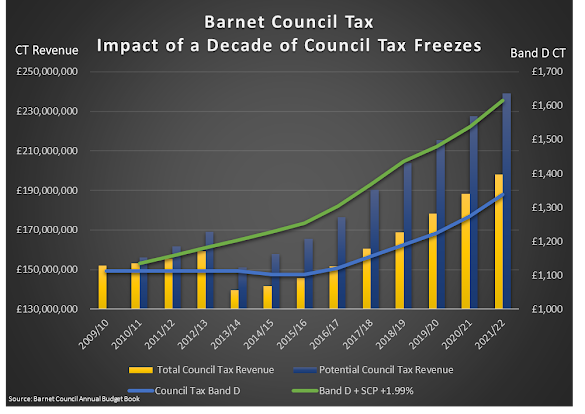
I decided to go back and update all the figure with a more detailed analysis of the impact of the freezes. Set out below is a graph which shows the impact of these freezes.


Getting into more detail I have set out in the table below, the basis of the figures. I tried to be as accurate as possible using not just the revenue figures but also the number of properties in paying council tax - the council provide the number of Band D equivalent properties as part of their calculations in the Council's Annual Budget Book/ Financial Forward Plan and Capital Programme

What the figures show is that if Barnet had taken modest rises of 1.99% every year instead of freezing or cutting council tax, by 2022 there would have been £41m a year more revenue coming from Council Tax. National government must also bear some of the blame as for a number of years the government subsidised council tax freezes for that specific year. But the problem is that a subsidy is only for one year but the freeze represents a recurring loss.

Labour are not entirely blameless as the year after they came in they reversed the 1% increase in council tax made the previous year by the Tories. The big problem is councils are around for the long term but politician come and go and the decision they make are often very short term and politically motivated. The residents of Barnet now face the consequences of those actions.

It is also interesting to not that the cumulative lost revenues over the period 2010/11 to 2021/22 is £273million which maybe could have been spent on improving the infrastructure and services in Barnet. The old saying, "you get what you pay for" is truism but it has consequences and we are seeing them realised now.


Tuesday, 18 July 2023

How covid victims' families are being ignored by Baroness Hallett and how people with disabilities were failed during the pandemic

I haven't blogged for a while as I have been a bit unwell but I received an email yesterday from someone in Barnet who I admire immensely and I feel compelled to pass on his story. 

John  & Ida Sullivan had a daughter, Susan, who I met on a number of occasions at various campaigns and marches about the Barnet Council under the previous Conservative regime. Susan, who had Downs syndrome, was a very lively and cheerful person. I didn't know until I listened to the podcasts, just what a talent Susan had as a swimmer, winning numerous medals at the Special Olympics. Sadly she caught covid at the very start of lockdown in March 2020 and died shortly after. What is shocking are the details John reveals in two podcasts:

https://goingviralthepod.libsyn.com/the-dancing-queen

https://goingviralthepod.libsyn.com/who-do-we-not-save

What I learned from these podcasts is how people with disabilities were treated differently and inhumanely during covid, how hospitals ignored the knowledge, experience and wishes of carers. According to research 6 out of 10 people who died from covid were disabled. John and his family discovered that because Susan had Downs syndrome and a pacemaker she was denied access to the ITU at Barnet General and deemed "not for resuscitation" even though her family had asked for her to be resuscitated and until covid she had been in excellent health.

John wants to give his evidence of how Susan was unjustly treated to the Covid Inquiry chaired by Baroness Hallett but sadly he will not be able to do so but instead a large amount of personal evidence will be 'amalgamated' by a research company into 'Every Story Matters' where "stories will be collated, analysed and turned into themed reports, which will be submitted into each relevant investigation as evidence. The reports will be anonymised". John doesn't want Susan's story amalgamated and anonymised. All Baroness Hallett was asked to do by the legal team for the bereaved families, was to hear the witness statement of just 20 families, and she refused. Making time for those 20 families seems entirely reasonable and fair in an inquiry where public hearings are scheduled to concluded Summer 2026. Surely there must be room to hear those 20 families in such a lengthy timetable.

At one point in the podcast John says "The only voice my daughter has got is me. I will, to my dying breath, fight to give Susan that voice, and all the other Susans, at the Inquiry."

I hope that Baroness Hallett thinks again and allows the victims' families to give their experience to the Covid Inquiry in person so that the real story of how so many disable people died during covid can be heard and lessons learned.

Wednesday, 5 April 2023

Latest spending figures from Barnet and a 'blast from the past'

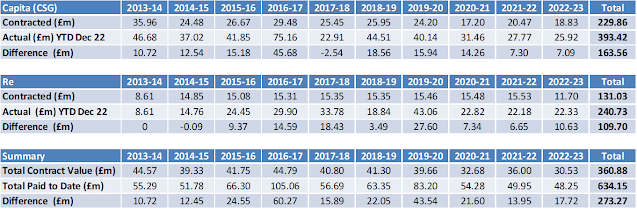
 Latest supplier payments are out and as the Capita Re contract draws to an end we see how much we are still paying Capita. In February we paid them £2.77 million on the CSG contracts and £503k on the Re contract. That brings the total to date to £641 million and we still have some payments to go. The Re contract has just ended so hopefully we will see the final payments at the end of the month when they are published. Barnet have extended the contract for a number of elements for the CSG contract so we will have a further three years of payments on that contract.


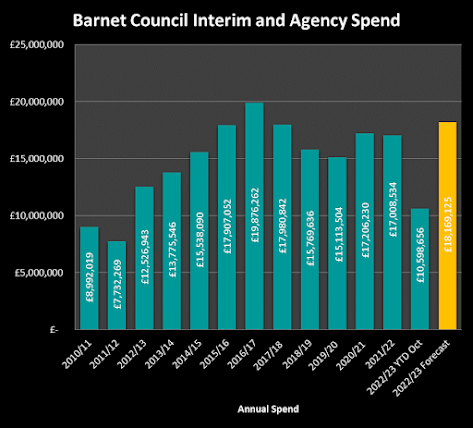
The spend on agency staff remains high and with one more month to go before year end it looks like we have already exceeded last year's spend at more than £17.3 million and are on course to hit the highest level since the peak in 2016/17. I hope someone is keeping a very close eye on this spend.


I was also interested to see a name I recognised from some while ago. Impower Consulting are, I believe, the same company that, alongside Agilisys, previously provided advice to Barnet on the mass outsourcing of services back in 2012 for the Capita contracts. They are definitely the same company who, in 2015, helped outsource the education services including school meals. Sadly the school meals ended up being sub-contracted out to another company so that the Council had no direct contractual relationship with the school meals provider and the education services contract was handed back to Barnet as soon as Covid hit in 2020, three years ahead of the planned contract expiry date. You can read about it here. This year to date we have paid Impower £133,692.96, a not inconsiderable sum. I hope it represents genuine value for money.

We have also spent £110,528 with a company called Peoplescout, a 'talent solutions' company which I think means recruitment. With all of the Re contract being brought back in house I suspect the cost of recruitment companies will be higher than normal but is something I will keep an eye on.

Finally is Brent Cross, where so far this financial year Barnet have spent £50.6 million. This follows on from £77.1 million spent in 2021/22, £70.8 million in 2020/21 and £45.5 million in 2019/20. I hope that all this expenditure is going to be worth it in the end.

I continue to keep an eye on Barnet's spending.


Thursday, 2 March 2023

Latest Capita Spending

 Latest spending figures are out and the Capita contract continues to cost us a fortune. In January Capita billed an additional £3.2m on the CSG contract and £620k on the Re contract. The latest running total is £638 million.


The spend on agency staff continues at a worryingly high level and looks like it will hit £18.7 million by the financial year end (31 March).


Monday, 13 February 2023

Capita continuing to disappoint in the death throes of the Re Contract

 Apologies for not having posted a blog for a couple of months but I am still monitoring Barnet and the Capita contracts.

The latest spending figures show that Barnet have now paid Capita £634 million which is £273 million more than the contracted value even though some services included in the contract value have already been brought back in house such as Finance.


I watched the Audit committee in January where Capita were requested to attend to talk about their performance. You can watch the Audit Committee meeting here and the part where the director from Capita participates starts at 27 minutes 20 seconds into the meeting. What is most disturbing is that now the contract for Re is coming back in house at the end of March Capita seemed to have given up on rectifying problems that already existed. Performance failure and the inability to meet deadlines was repeatedly raised. At 41mins 14secs, one of the independent members of the Audit Committee does some plain speaking about Capita's performance which has been poor and is definitely worth watching.

While the Capita Re contract will come back in house on 1st April there are still significant elements of the Capita CSG contract will continue to be operated by Capita for another three years and that fills me with serious concerns. Barnet is a case study in how not to outsource services, with overly complex contracts and weak monitoring. I will keep watching Capita's performance.

Monday, 28 November 2022

Looking back almost twelve years - the pledge I made that was never accepted

 I was going through Barnet's supplier payments for October 2022 (£71.7 million) and I cast my mind back to January 2011. At that time the council implemented something called Pledgebank where residents could pledge to carry out some activity on behalf of the council/community. My pledge was as follows:

“I will pledge to give up 4 hours of my time every month to scrutinise and challenge all invoices over £10,000 to help the Council reduce unnecessary spending so long as five other people will make a similar time commitment to sit on the panel and that Barnet Council will genuinely participate in the process and listen to the advice and opinions given.”

Strangely, the council never took me up on my pledge although, rather than decline it, they left it hanging, "undecided" as they put it. You can read about it here.

Why I raise it now is that when costs are so tight and we potentially face serious cuts to services due to the impact of the crazy mini budget of 23 September, every penny spent must be carefully watched and if necessary challenged.

This month, excluding redacted payment, we paid 1,021 suppliers £69.27 million. The top 20 suppliers were paid £48.83 million or 70.5% of the total spent. Looking at individual payments there were a total of 14,811 of which 521 were for £10,000 or more, around 3.5% of the total invoices. Excluding payments to statutory authorities, that number falls further. Maybe now is the time to revisit that pledge?

Barnet also spent just over £2 million on agency staff in October which brings the year end forecast to £18.2 million, up on last year and set to be close to the peak year of 2016/17.


And just to update you on Capita, the running total is now £622.74 million. Scrutiny is more important than ever.