Showing posts with label lack of transparency. Show all posts

Sunday, 1 May 2022

Please read this before you vote

 It is the local election on Thursday, the one and only time in the four year cycle when the council actually have to pay attention to the views of residents through the ballot box. 

There is a lot of spin at this time but I just want to look back over the last four years since the last election and see what has changed for the better or worse. 

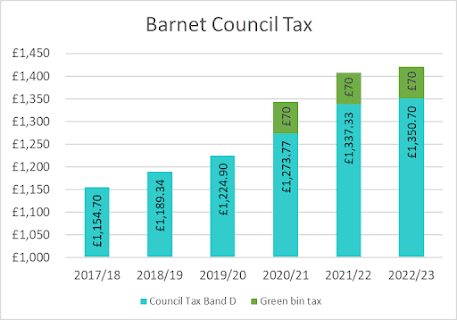
Council Tax has risen significantly over the last 5 years and no matter what Conservative councillors may say, the council tax has risen every year, including this year - so no, not a freeze. Set out below is a chart showing the increase year on year. (This excludes the amount paid to the GLA)


In addition, if you have a green bin, you now have to pay an extra £70 a year to have that collected, a clever way to avoid showing the real increase in council tax. Now don't get me wrong, Barnet had no option but to increase council tax because previously they had frozen council tax and in 2014 actually cut council tax by 1% just before the 2014 election. What irks me is the way council taxes went up by 3.99% and 4.99% in the last two years so that, in an election year, the increase can be limited to 1% while saying it is frozen.

Bin Collection is also a matter the local Conservatives are keen to focus on. They promised they would keep weekly bin collections in 2018 only to withdraw the brown bin food waste collection weeks after the election and two years later introduced the £70 green bin charge. Barnet is the only London borough not to have a dedicated food waste collection. Instead of sending the waste for anaerobic digestion which is environmentally friendly, generates electricity from the gas produced and provides a valuable fertiliser as a by-product, we send it to the Edmonton to be burned in the incinerator. Interestingly, there was a business case developed in 2018 by council officers to move to fortnightly general waste collections which, with a retained weekly food waste  and recycling collection, could not only have saved more than £900,000 a year, but would have helped to push up recycling rates by forcing people to separate out their waste more effectively. Political ideology won the day at the cost to Barnet residents and the environment.

Transparency is another thing which has deteriorated over the last four years. In 2019 Barnet Conservatives introduced new rules which stopped Barnet residents from addressing committees in person and dramatically limited the number of questions that could be asked. It was claimed that this would save £42,000 a year of officer time answering questions posed by residents at committee meetings. In reality it was simply to stop residents asking serious questions about the way the council was being run. There was always a time limit of 30 minutes in any committee meeting for residents' questions and speeches, speeches were limited to 3 minutes and questions were taken turn and turn about so no one person could take up all of the time with their questions. Occasionally, not all of the questions were addressed in the 30 minute slot, but at least there was a written record of the council's response. Now, you are not allowed to address the committee in person or be questioned by committee members, you get one question per agenda item and no more than two people can ask a question about each agenda item. When you are dealing with the annual budget, one question simply isn't enough. For example, at the Policy & Resources Committee in February this year, the papers for the budget agenda item comprised 386 pages including, changes to charges levied on residents, debt management policy, capital strategy, risk register, housing revenue account, medium term financial strategy, to name but a few, yet residents are allowed to ask just one question. I suspect that the real reason for gagging residents was not to save an alleged £42,000 from a council budget of  £344 million, but to stop a well informed and curious resident base from asking difficult and inconvenient questions.

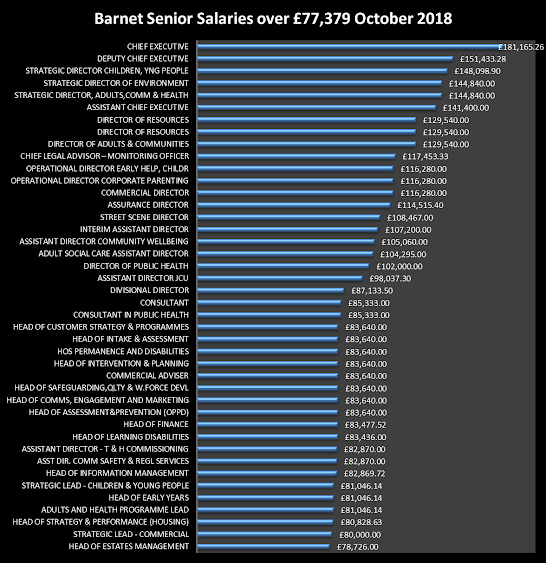
We have also seen other changes on transparency such as the removal of senior officer salary data. We used to get a detailed breakdown of how much all officer paid over £55,000 a year were paid. Below is a graph I used to produce showing how much each officer was paid - I limited the range to those officers paid more than an MP and I never published the officers' names even though the data was available.


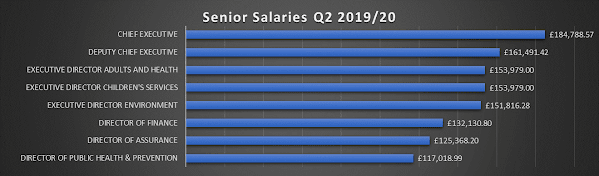
The data available then changed so this is all that was published.

Not only was the number of posts listed dramatically reduced but all the historical data was removed from the council's website. I suspect this was because there was a level of transparency which allowed residents to see the increases received by some council officers when their posts were regraded or when they received above inflation increases. No data has been published on the Council's website since September 2019.

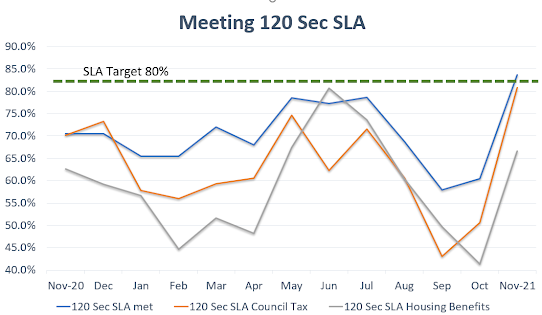
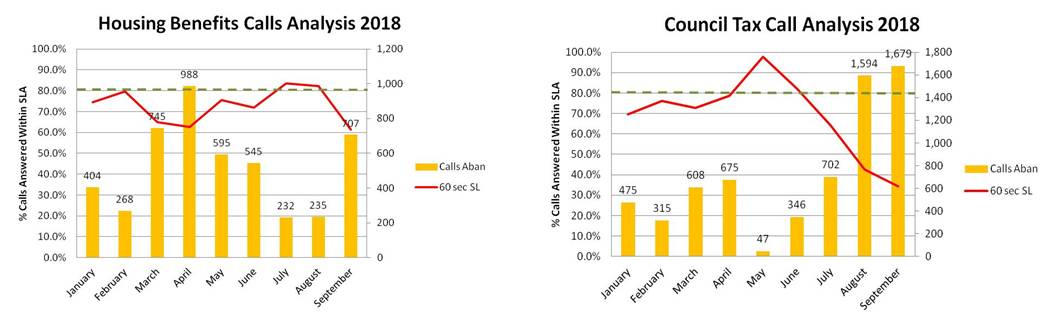
Performance of the Capita contract has also suffered from a lack of transparency. Historically, a table known as "Benefits Realisation" was provided for the Capita CSG contract which showed how much (or little) the Capita contract had actually saved. When it became clear it wasn't saving anywhere near what we had been originally been told, they stopped publishing it. Data on Capita's performance at answering the phone to Barnet residents also stopped being published until just recently, and after much pestering from me, as it showed how poor the performance actually was. Having changed the targets twice to make them easier to meet, the latest data shows Capita still aren't answering the phone within the target time of 2 minutes and the data set remains incomplete.


Minutes of the Strategic Commission Board (Council Management Team) used to be published. They were not normally that informative although from time to time they included real insight into the way the council operates. In one set one minutes from February 2018 but published after the election, it highlights a practice known as 'telephony service degradation'. I suspect it was linked to an issue I  raised as part of the inspection of accounts which highlighted that if calls to Barnet exceeded a certain threshold, Capita were able to charge extra and in the financial year 2017/18 that amounted to an extra charge of £247,000. As a way to generate savings, the proposal was to introduce  'telephony service degradation' i.e. make the service worse so as to reduce the number of calls being answered and thereby cut the extra charges being made by Capita. Barnet stopped publishing these meeting minutes before the start of the pandemic and have yet to restart their publication.

Development is another contentious issue in Barnet. Conservatives are saying that they are opposed to over development but if you look at the huge amount of development along the A5 that clearly does not apply there. I know some of the people impacted by the Sainsburys development at the Hyde where Barnet pushed through a development of 1,309 flats in blocks up to 28 storeys even though it sits outside the agreed development area and is not in a town centre. All of their views were ignored including the home owners which will be very badly hit by loss of light. We now have a series of developments which will create 2,500 new flats on a 400 metre stretch of the A5 but without the infrastructure to support anywhere between 5,000 and 7,000 new residents.  The massive development at Homebase in Cricklewood was another example where Conservative councillors were saying what an awful scheme it was yet voted for its approval. Yes, we need new homes especially for families, but what we are getting is a mass of small 1 and 2 bed flats which remain out of reach for most of the people who actually need them.

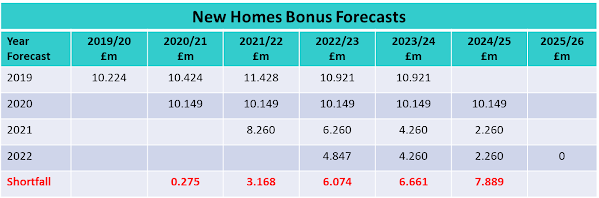
Barnet became addicted to a central government grant, New Homes Bonus, and in 2019 were forecasting an average of £10.8 million per annum. The more homes you built above a threshold, the more New Homes Bonus you received. It was a crude measure to boost housing builds but Barnet saw it as a useful revenue stream and so were incentivised to build more and more homes, typically 1 and 2 bed flats even though the top priority is for three bed homes for families. However, each year since 2019, that has been adjusted down so that next year we are now forecasting only £4.8million compared to an original estimate of £10.9 million. I raised this issue in 2019 of how reliable New Homes Bonus payments would be, but that was dismissed as pessimistic. It is exactly for these reason that residents need to be questioning the council and why gagging residents is so short-sighted.


The most recent example of Barnet's planning committee not listening to local residents is the Hendon Hub, a massive development at The Burroughs in Hendon which will destroy the beautiful, albeit downsized, Hendon library and a scheme which Historic England did not support. Local residents have launched a Judicial Review. You can read more about the Hendon Hub here.

This leads into our Library service and the way it has been decimated over the last five years. We were told that this was all about saving money and that people didn't really need libraries in an age of kindles, but now more than ever, when people are choosing whether to eat or heat, monthly broadband charges look like a nicety, not a necessity. Libraries were great places for people who didn't have internet access to work, study, apply for jobs, search out information and carry out other day to day functions, not just about somewhere to read and borrow books. In New Barnet, when the writing was on the wall for the old East Barnet Library (2017) I asked if it could be relocated in the proposed new leisure centre which would allow it to stay open all the hours the leisure centre was open. It was still too small but at least if it was open 90 hours a week it would allow people to access books, study space and the library computers. The reality is that we have a library located within a leisure centre open 90 hours a week, with a manned reception right next to the library area, yet the library is only open for just 17 hours per week. With the prospect of  thousand of people moving into New Barnet in the assortment of new developments, a tiny room open just 17 hours a week does not seem like a library we should expect. If you live in New Barnet you will get a chance to visit it on polling day as it is the local polling station - however you will not be able to use the Library - voting only.

Care Homes is another area which Barnet outsourced and which has proved to be a disaster. Apthorp Care Home was outsourced to Catalyst and run by another company Fremantle. You can read all the details here but the net result is the care home was run into the ground, the care offered was appalling and rated inadequate by the CQC. There was a massive backlog of repairs which meant living conditions were unacceptable. Fremantle handed back the running of the home to Barnet in 2019 and in 2021 Barnet decided that the backlog of maintenance was so bad that they would close the home. Now this isn't an old home, it was only opened in the early 2000's. I asked about monitoring in the period before the damning CQC report and it was clear that Barnet did not keep a log of all the monitoring visits nor was there a sanctions or penalty regime in place to make the provider improve. They outsourced the care of our elderly family and friends and did not do enough to ensure their care was safe and secure, something which is unforgivable.

Capita contract is the other issue that remains a running sore in Barnet. In 2018, after the election we told about a massive fraud carried out by a member of Capita's staff, stealing over £2 million in 62 separate transactions over a period of 17 months in 2016 and 2017. The fraud went undiscovered and only came to light after the fraudster's bank alerted Barnet Council to the potential problem. Grant Thornton were brought in to see how on earth such a massive fraud could take place and their findings showed fundamental weakness in the Capita systems and, that " there has also been insufficiently close scrutiny and client side management on the part of the Council and the Chief Officers coupled with an over reliance on the limited scope and frequency of work carried out by the Internal Audit service, to highlight issues. This is likely to have contributed to the lack of focus on effective controls". 

This was followed in 2019 by another fraud in the Capita run Pensions admin department, this time  seven different payments for a total of just over £70,000. Yet again Capita systems were found to be wanting. 

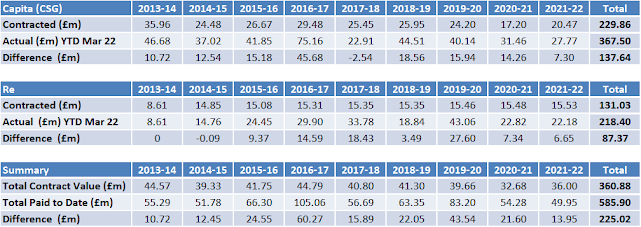
Set out below is the current cost of the Capita contract and shows that so far we have paid Capita £586 million, £225 million more than the contracted sum. It is also important to understand that Barnet have already taken back a number of services including Finance and HR which were in the original contracted sum so, in reality, we are paying even more than is shown.


Following the major fraud, the finance function along with HR was brought back in house and Barnet has been discussing what elements will be returned to the council ever since. We still do not have a definitive list of which council services that will be retained by Capita and we won't get a decision until after the election even though this should have been decided more than two years ago. In 2021 the review of Capita services was accompanied by a “Market Insights” report prepared by Grant Thornton in which the Executive Summary opens with the statement:

“Historically procurement has been ideologically driven and highly political”

 It also goes on to say:

“The gap between cost and efficiency for delivery between the public and private sector has been significantly squeezed over the last decade as a result of market pressures. This means that outsourcing is not always the most cost effective option by default”

I think this first statement sums up so much about the way Barnet Council has been run, ideologically driven and highly political. 

So when you are thinking about which way to vote on Thursday, ask yourself if you want another four years of the same or whether you think there is a better way to run Barnet. Whatever way you vote just please make sure you use your vote, as it will be the only way to show your views and to get politicians to listen for the next four years.

Thursday, 9 September 2021

Just what we pay Capita - How they billed £555 million to one council

 As readers will know, I have followed the two Capita contracts in Barnet since the very outset when the outsourcing of so many council services was first mooted. To date, Capita have been paid £555 million and there are still just over two years of the contract to run. 


The difference between the contracted sum and the total paid currently stands at £218 million, a large amount around which there is very little transparency for these additional or 'extra' charges. It was a Conservative Councillor, Hugh Rayner who asked the obvious question before the Capita contracts were let. He said that he likes extras, changes or variations to a contract because that is where he made his money and challenged officers to tell him how we would avoid this situation with Capita. Sadly he was right and the over optimism of politicians, consultants and officers at the time has proved very expensive. (Credit to the late Barnet Bugle who filmed so many of those council meetings providing a permanent record of the mistakes and blunders made by councillors).


 Each year there is a period of 4 weeks when any resident can inspect the accounts and this is my annual opportunity to see precisely what 'extras' we are paying for and question whether it is valid or appropriate. This year I requested copies of  439 invoices reconciling the total £54.28 million paid to Capita and in particular what the £21.6 million of extra payments included. It takes a bit of time to not only go through all of those invoices but to understand the specific breakdown of what they include.

At this point I have to give some praise to Barnet Council. Yes you read that right, praise, specifically to the council staff in the finance department. Barnet brought the finance function back in house from Capita a couple of years ago after a range of problems. I think the staff know me reasonably well so this year when I asked for copies of all the invoices and breakdown of what they related to I was surprised that even though I had put in my request early, assuming it might take them up to three weeks to compile, I was sent a fully detailed set of invoices and back up within 24 hours. So well done to all the Council finance staff  - excellent service!

Reading the details of what was in the invoices is both worrying and puzzling in that I keep asking myself why on earth this contract wasn't brought back in-house years ago. Set out below is a summary of the main categories of spending on the 'extras'.


The first three are items which there is limited room for manoeuvre:

Pensions is what Barnet have to pay for additional pension costs for staff who transferred over with the contract including payouts and changes to the scheme. We don't have any choice over these payments.

Indexation is the uprating of the contract value in line with the inflation rate. I am sure many people who have seen their pay frozen or cut over the last 8 years would welcome a clause where their pay automatically rises by inflation each year. Most other council departments have no guarantee that their budgets will be increased by inflation but it is a contractual clause so we are stuck with it.

Procurement is where Barnet request additional item, I understand this is mainly IT equipment. As it is stuff that Barnet have specifically requested then, again, there is little we can do about that. 

We then come on to the other three headings which are more interesting and where I have real concerns.

Gainshare is a term whereby Capita share in any savings that they make on behalf of the council. In the past this figure was much larger as it included savings made on procurement. I have fought these from the outset of the contract and exposed what a sham they were. Eventually after much hassle from me and from the my challenge to the accounts being overdue for two years, a settlement was reached with Capita whereby gainshare was removed from procurement items. I was told by someone who should know (I will not mention their name to save them the embarrassment) that my persistence had "saved the council million of pounds" by getting the clause removed. They also urged me to keep looking and keep questioning. This year the majority of gainshare was generated on  three areas, council tax collection rates, removal of single person discounts, savings on court costs. This year Capita received £480,197.59 for achieving council tax collection rates above the target set out in the contract. It related to this year and if they managed to recover unpaid council tax in previous years. 

The next is the removal of single person discount. Capita are paid a fixed fee of £127,200 to pay for staff to chase up  people claiming the single person discount and then on top of that they get a share of the additional council tax generated by removing the single person discount. Last year that share was a further £139,735.53 giving a total payment to Capita of £266,935.53. If you are living alone in a property and you have been hassled about whether you are entitled to a single person's discount then this is the reason why - because Capita make money if they remove that discount.

For both Council Tax Collection rates and single person discount removal, I have always felt that we should not just be handing over so much money when there are skilled people within Barnet's own team of staff who could pick up on this. We have a Corporate Anti Fraud Team (CAFT) run by an experienced senior officer who already investigates, tenancy and right to buy fraud, blue badge, freedom pass and parking permit misuse as well as larger corporate frauds, such as the £2 million fraud undertaken by a Capita staff member back in 2018. They also "use internal data matching in order to develop more data led pros-active investigations and allow CAFT to have a greater ability to investigate and adopt a preventative measures approach to a number of council services". If they were given just a small percentage of that £750k paid to Capita to add to their team, we could save the rest for important services the council is currently being forced to cut.

The court costs gainshare is paid at 20% of court costs collected above the baseline.  My argument has always been that if we have a year where court costs are high (possible due to more actions being taken) then is it likely Capita will recover above the baseline which is a fixed sum. Last year this amounted to £101,719. 

There were a number of other gainshare sums including £76,000 on Estates gainshare which is where they exceed targets on rental from commercial properties owned by the council.

The next large area of costs is Brent Cross where Capita billed £4.94 million in fees for work on various elements of the Brent Cross redevelopment. Until August last year Capita were also responsible for project managing the new Thameslink station at Brent Cross. However, they were replaced by a company called Mace who also billed £1.38 million in professional fees. To be clear the Capita costs are just for their fees not for actually building anything. Last year  2020/21 Barnet spent £70.8 million on the Brent Cross project, up from the £45.5 million spent in 2019/20.

Credit: Brentcrosstown.com
The last area is Special Projects of which there have been many over the years. These are individual projects that have been commissioned by Barnet and on which Capita have an automatic right to operate without the need for a competitive tender. In the past I have been told that the day rates are competitive with other external companies but the issue here is not just the day rate but just how many days are billed. 

One of the largest special projects this year includes £2.28 million on the Hendon Hub where
Capita provide professional services for the development and submission of planning applications and the Final Business Case. That is an awful lot of time for a project that isn't even built yet and there are likely to be additional charges and the work continues in this current financial year. They also billed £37,639 for "Heritage Advice" on the scheme.

In addition we paid:

  • £710,247 for "ICT Technical Resources"
  • £631,134 for assistance in helping to increase the SEN classroom capacity
  • £528,488 for "IS work packages"
  • £270,621 for staff to help with the "Customer Transformation Programme" 
  • £225,610 for schools modernisation work
  • £207,159 for desktop computer refresh
  • £162,871 for the decommissioning of North London Business Park offices, the offices that should have been vacated 5 years earlier.
  • £100,256 for a study looking at increasing building capacity under Covid-19 regulations
  • £90,608 for work on the lease surrender and decommissioning IT equipment out of Barnet House 
  • £86,544 for temporary staff to help in anticipation of an increased demand for renewal of the garden waste (Green Bin) stickers as well as £22,534 for staff help for the start up in March 2020 but billed this financial year.
  • £78,926 for fire risk assessments.
There were lots of other project although a few that caught my eye including:
  • Capita were paid £12,078 to identify a new libraries system and guess whose system they chose.... Capita Libraries - who else! At the same time they were  billing £106,670 for the hardware upgrade or replacement of Bibliotheca equipment across the libraries estate, to support Windows 10 operating system. Windows 7 is no longer supported by Microsoft, so an update is required, which will include other solutions, such as  self-check kiosks, Open+ self-service and CCTV video. 
  • Capita were paid a modest sum of £8,740 for a project known as the trickle transfers. This project involves the potential of transfer of around 300 council homes to Opendoor Homes (ODH), which will take over ownership/management in return for a capital receipt and income stream to the council. Instead of paying council rent at the lower level, new tenants will pay a higher social or affordable rent. The homes will only transfer when they are empty. The issue here is not that Capita were paid just under £9k but that they are working on a project to reduce the number of council homes available. I understand that the council policy long term is to transfer over as many council homes as possible as they become vacant to this higher rental level reducing affordability to the most vulnerable.
To all of this you may say "So What?" My concern is the lack of transparency about so much of the goings on in Barnet, something they have been making even more difficult as the years go by. We are gagged at meetings, and the amount of information they used to produce has been reduced. For example, Barnet used to produce a quarterly, one page summary of the benefits the Capita contract had generated (Benefits Realisation). When I started asking questions about the numbers, Barnet's response was to stop publishing it. I used to analyse the senior council staff salaries from data they published. One day they just stopped publishing it. I never published staff member names even though it was available only ever their title. Now we haven't a clue other than for the top handful of staff. Even worse they removed years of historical salary data that had already been published.  

I do this because someone has to try and hold the council to account!

Monday, 31 May 2021

Highly Political and Ideologically Driven - The Capita Contracts in Barnet

 It has been some time but Mr Reasonable is back! During lockdown and the incredibly tough time that we have all experienced, I thought I would ease back on my detailed scrutiny of Barnet Council and allow it to get on with what was a much more important job of looking after the residents of Barnet during this crisis. Throughout the entire lockdown period many vital frontline services have continued to operate and my thanks goes to all those incredibly brave and hardworking staff who have never had the option to work from home. However, council committee meetings have resumed in person so now is the time to resume detailed scrutiny.

Yesterday I reviewed the latest position on the Capita contracts in papers published for the Financial Performance and Contracts Committee which you can read here.  It sets out plans for which of the services currently operated by Capita will be brought back in-house, which will be reviewed after a year and which will continue to be operated by Capita after the contract expires in 2023.

In the past I would have taken my views and a long list of in-depth questions to the committee meeting in what would, in a normal democracy, be seen as public scrutiny. However, as we all know, in Barnet the current regime hate any form of scrutiny so they have gagged all those people who take a close interest in how the council is run.  I am allowed just one question on the contracts costing an average of £72 million a year. 

To set the Capita contract in context, set out below is the total Barnet have paid to Capita since the contract started in September 2013. As you can see, so far Barnet have paid Capita £540 million, £212 million more than was originally contracted.


When I meet people who are unfamiliar with Capita’s role in Barnet, they often ask if I am joking when I say that one council, Barnet, has paid over half a billion pounds to one company, Capita. The level of disbelief is huge but that is the reality of the contract councillors entered with Capita back in 2013.

The paper being discussed next week sets out where they have got to in reviewing the two contracts and the strategy going forward, something they are asking councillors on the committee to agree. Bear in mind that the CSG contract review should have been completed two years ago and the Re contract a year ago. It is accompanied by a “Market Insights” report prepared by Grant Thornton in which the Executive Summary opens with the statement:

“Historically procurement has been ideologically driven and highly political”

Definitely 100% true in Barnet’s case. It also goes on to say:

“The gap between cost and efficiency for delivery between the public and private sector has been significantly squeezed over the last decade as a result of market pressures. This means that outsourcing is not always the most cost effective option by default”

Unpicking that statement and reading between the lines, it is saying that the price difference between companies like Capita and in house teams is slim, if at all, something I told Barnet back in 2012 and 2013.

The killer line is at the bottom of the executive summary where it says:

Key to pragmatic delivery and understanding is an effective and objective options appraisal process with a clear vison at the outset of 

‘WHAT ARE WE TRYING TO ACHIEVE’ and 

'WHAT PROBLEMS ARE WE TRYING TO SOLVE’

The council failed to address those two critical questions in 2013 and reading the committee paper they still have not been addressed nearly eight years later. Indeed the current paper seems to have been written from a Capita centric view point with services from which Capita can continue to make money being retained and those that do not generate profit/make a loss, or don’t fit the model of what Capita want to provide, being returned to Barnet. 

For example, the reports says it makes sense for Capita to keep IT, customer service and revenue and benefits. All three of these services have contract clauses that allow Capita to charge extra for exceeding volume thresholds. The biggest money spinner of all is planning, a service which is intrinsically linked to local knowledge but which Barnet seem happy to let Capita keep creaming off a profit share. I am aware that there has been a high turnover of staff in the planning department and this has led to a real loss of local knowledge when planning applications are put forward. Knowing planning law may be seen as the most important criteria but I would say that having some local knowledge, is right up there when deciding planning applications. One possible reason for the high turnover of staff is that the biggest employer of planning officers are other local authorities who offer the benefits package, especially pensions, that Capita fail to offer.

Set out below is a summary of how the different services will be managed; retain means retained by Capita and returned means given back to Barnet to manage. I have dealt with the issues involved with each service individually below the table.


IT – “whoever controls the data controls the world” applies at corporate level as well. Without control of the IT systems we are forever dependent on Capita. A couple of years ago when there was a major review of spending being carried out, some of the shortcomings of Capita’s Integra system were highlighted, especially budgeting for capital project over more than one year. The then acting Finance Officer (who I rated highly) said that computer systems such as SAP had the ability to schedule capital budget over many years and he has used that at other Local Authorities. The irony of the situation is that Barnet had spent more than £20 million developing and perfecting an SAP system only for it to be thrown out and replaced by Capita’s Integra system when we signed the contract back in 2013. In this paper they have recognised the need to improve of the Integra systems and are saying that by extending the contract, Capita will make investment in this area. 

WARNING!!! 

This is a complete and utter myth. Back in 2013 Barnet councillors said they did not have the money to invest in IT systems and that is why they needed a company like Capita who would invest their own money in new systems. However, as soon as the contract was signed they completely reversed that decision saying that it was much cheaper for the council to borrow money than Capita and put up £16.1 million which they said saved the council £800,000 in interest that Capita would have charged. The same will happen again this time.

Customer Services – The report says that this service has performed well. Not what Barnet residents were saying pre covid when getting through to the council on the phone system was a nightmare. I demonstrated that on some departments Capita had never met their full quarter KPI targets on answering the phone since the start of the contract. 


Barnet’s response was clear and decisive…. they stopped publishing the data so that I could not point out the failings any more. Capita also charge extra when call volumes exceed target levels, even though many of the calls are now fully automated (quarter of a million pounds in 2018). The Covid pandemic has seen a massive change in the way calls are handled with call centres closed and most calls dealt with by staff from their homes. Why haven’t Barnet looked at doing this themselves?  Covid has forced many people in the hospitality and retail sectors out of work In addition, there are always people looking for fairly paid part time work, especially working mothers who need to balance childcare with work. Why aren’t Barnet looking at utilising these local staff working from home as a way to create better paid local jobs using people with good local knowledge. Sadly this is a prime example of ideology trumping pragmatism.

Revenues & Benefits – This service is now the largest recipient of the wonderfully titled “Gainshare” clause. With this clause, if Capita save some money or gather more than was forecast 9 years ago when the contract was drafted, then they get to keep a proportion of it – up to 50%.  Last year Capita claimed £837,218.66 using this clause including £180,421.92 gainshare for exceeding the council tax collection target,  £125,057.81 for gainshare on recovered housing benefit over-payments and £230,702.89 for reducing the number of people claiming single person discounts. Times and technology have moved on. It would be good to see Barnet hanging on to all of that £837,000 rather than handing it over to Capita.

Procurement – after years of campaigning and highlighting to both Barnet Council senior officers and to the External Auditor how much we were paying out unfairly in gainshare to Capita on procurement, gainshare on procurement was dropped as part of a secret deal done between Jonathan Lewis, CEO of Capita, and Barnet back in November 2018. This clause had generated just under £8 million of gainshare for Capita so was extremely lucrative. Without it Capita simply can’t be bothered so that is why they are handing this service back to Barnet.

Accounts Payable/Integra – Barnet are proposing that this service is given a short extension with a further review even though Accounts Payable has been one of the worst performing services of those provided by Capita. Since the start of the contract Accounts Payable has received four limited assurance reports from Barnet’s Internal Auditors in January 2015, January 2016, April 2018 and October 2019. This department’s failures were also highlighted by Grant Thornton in their investigation into the £2m fraud discovered in 2018. What else is to review – they have provided consistently lousy service and should have been sacked back in 2018. The report also talks about economies of scale but this is already a massive operation. In 2020/21 I logged and tracked 162,468 payment transactions and those were only the ones made public. Accounts Payable needs attention and is large enough to warrant being brought back in house where hopefully we would get more scrutiny on what is being paid out.

HR/Core HR - a large part of this service has already been brought back because of serious failings. It therefore makes sense to bring the rest back when the contract expires yet Barnet want to extend and review this service. Why? Ideology over pragmatism.

Estates – another service earmarked a short extension and further review. Reading the report it is hard to understand why when it says “Overall, the Estates function has had a number of problems over many years, which go back to before the CSG contract was put in place. Repeated efforts to resolve this over the years have made some improvements, but the service is not yet consistently performing to the required standard”.   The only conclusion I can come to is that Capita want to hang on to it because while they provide a dismal service, they can still claim gainshare on property income where Capita keep 30% of the additional income from rent reviews, lease renewals and letting on the property portfolio above an agreed baseline. Last year that was just over £100,000. Are you starting to see a pattern here?

Planning Control & Development – Barnet is in the top ten of busiest planning departments in England (2,694 applications in 2020), something from which it generates a large revenue stream. The head of planning was a Barnet council staff member before the contract was outsourced so I am not sure what value Capita have brought to this contract but currently we have to share the planning income with Capita. Given that there has been so much criticism of planning and the accusation of conflicts of interest with other Capita companies such as GL Hearn, it would seem like an obvious choice to bring back in house. In this case the financial interests of Capita win again.

Building Control and Land Charges – again both revenue generating service where profit has to be shared with Capita so yet again the recommendation is to leave the service with Capita.

Regulatory Services - these include Environmental Health, Trading Standards and Licensing and they are recommended to return to Barnet’s control. Definitely, the right decision and one where right back in 2013 it seemed unwise to hand to a contractor. Possibly of more relevance is that none of these services make money so are therefore of no interest to Capita.

Regeneration – is also a strategic service which generates no income for Capita so surprise, surprise the recommendation is that it should return to Barnet. It is important that the service is run and controlled by Barnet staff but it is clear to see why Capita aren’t putting up a fight to keep it.

Highways – this is another service that has performed dismally under Capita. They have struggled to recruit and retain senior management for this service. It received a 'Limited Assurance' rating in April 2017 and a 'No Assurance' rating, the worst possible, in October 2019. Indeed at the most recent Audit Committee meeting in April this year, the deadline for resolving the problems identified in the 2019 report had been missed again – for the 5th time. Capita do not physically carry out the highways work; that is let through a London Councils framework contract, they just manage it. The report is also contradictory on this service saying in the text that the service should be returned yet in the chart saying it should be extended with a further review. Which is it?

Cemetery & Crematorium – the report says that Capita aren’t doing a bad job. Others who had a loved one’s memorial bench chucked into a heap in the Hendon Cemetery memorial garden and who have seen the process of death “memorialised” to use Capita’s jargon, might disagree. However the service doesn’t fit with Capita’s strategy “and is the only cemetery and crematorium they (Capita) run. Whilst this does not present any immediate issues of concern, the potential for them to add further value to the development of the service over the medium-term may be limited”. So yet again they are handing back a service not because of any pragmatic or logical reasoning but because it doesn’t fit with what Capita want to provide.

Reading this report I am shocked that it is so one sided and biased towards what is best for Capita rather than what is best for Barnet and its residents.

The Grant Thornton Market Insights report raises a number of interesting points including information about councils that are insourcing (bringing back in house) services that were previously outsourced.

As I mentioned at the outset, local residents are not allowed to ask more than one question and if more than two residents want to ask their single question about an agenda item then they are simply ignored. We will be invited to a focus group session in early July and one later in the year in the same format as 2018. In that focus group they gave everyone tea and biscuits and £50, (I donated my fee to charity) listened to what everyone said and then completely ignored every single word. It ticks the box for consultation without listening to a word that is said.

This is a contract which has already cost £540 million yet this report seems superficial and entirely biased in favour of Capita. Grant Thornton are right when the say procurement has been ideologically driven and highly political. Unfortunately that seems to still be the case in Barnet. No big picture, no wholistic viewpoint, no recognition of the links between services that make a council function efficiently, just more of the same old fashioned ideology where Capita’s needs and strategy are at the forefront of any decision.

Sunday, 4 October 2020

Brent Cross - what are the risks of this massive scheme

As part of my recent inspection of the accounts, I identified that Barnet had paid Capita £14.1 million on the Brent Cross project. A significant sum, but what I also discovered was that last year alone Barnet paid out £45.5 million on Brent Cross and a further £30.3 million since April.  Much of this money is recovered through a central government grant but what worried me was the lack of transparency about what is happening with this project and how the financial risk to local Barnet residents is being managed. 

According to the Barnet Council website:

"One of the biggest regeneration projects in Europe, the Brent Cross Cricklewood scheme will see the comprehensive regeneration of 151 hectares to create a sustainable new town centre for Barnet and North London including substantial residential and commercial uses.

The project comprises three components:
  • Brent Cross London — a modernised and extended shopping centre and improvements to critical road infrastructure as well as cycling and pedestrian access. Delivered by Hammerson and Standard Life Investments. 
  • Brent Cross South — the creation of a new high street south of the North Circular, including 6,700 new homes, commercial development and new and improved community facilities and public spaces.
  • Brent Cross Thameslink — a new, additional Thameslink station and associated infrastructure works to provide pedestrian, cycling and vehicle links across the railway, and replace outdated waste and freight facilities". 

Each element is quite different with its own history and risks.

Brent Cross London:

Originally, the shopping centre was to be expanded and redeveloped and the additional business rates it would generate would be ring fenced to pay for the new Thameslink station. 


However, even before Covid-19, the retail sector was struggling and in 2018 the planned extension was stalled. This had a serious impact on the funding of the Thameslink station so Barnet were forced to go to Central Government to get them to underwrite the station construction costs. 

With the shopping centre redevelopment on hold and Government have agreeing to step in and fund the Thameslink station what is not clear is who will fund the north side infrastructure and how dependent Brent Cross South is on that infrastructure. For example,  I understand that Brent Cross London are responsible for the replacement of the Templehof Bridge and the construction of the new Living Bridge. My concern is what happens if this infrastructure is not built, is it critical for the additional traffic flow to the southern development and is the energy centre on the north side linked to the southern development? Also, it is not clear what will happen to the development of plot 114, identified for housing, and the re-routing of the River Brent and how important they are to the success of the overall project. The shopping centre site is large, with a tube station to the east and the new Thameslink station to the west. My big concern is at what point does the site become worth more for housing than for a shopping centre and if that happened what impact would it have on the Brent Cross South development.

Brent Cross South:

This is a massive development with around 6,700 new homes and 3,000,000+ square feet of office space along with shops and restaurants. It also involves the rebuilding of three new schools, including an expanded Claremont Primary School. To make this development happen required the compulsory purchase of a number of homes, including the Whitefield Estate, and these tenants will be rehoused in the new development as shown below.


Brent Cross South differs from the shopping centre site in that Barnet Council are joint venture partners, something they entered into in 2016. You can read the details here. This JV entitles the Council to share in profits generated by the scheme. Senior council officers sit on the Joint Venture Board but there is also a Shadow Shareholders Board made up of five councillors who are suppose to "meet monthly to monitor and review project progress, and to consider and make decisions as required by the Council in its capacity as shareholder". I have never seen any minutes of these meetings nor do I know if they still sit. They may well be doing so but the issue here is about transparency.

Prior to Covid-19, the level of risk may on this development may have been much lower, but working from home looks like it may have a permanent impact on demand for office space. With plans to build 3,000,000+ square feet of office space, there must be a real concern about whether there will still be demand for this amount of office space on the North Circular and who it will be targeting. The developer, Argent, was also responsible for the Kings Cross redevelopment which has attracted high profile tenants, such as Google and Universal Music. However, Brent Cross is definitely not Kings Cross and, as such, it is not clear who they will be targeting and how successful they will be in securing tenants. The other big risk is that it simply sucks out office tenants from existing Barnet town centres, moving jobs rather than creating them.  


While Canary Wharf is a beacon of success today, I am old enough to remember how the original developer went bust due to the downturn in the office market in the early 1990’s, something that must at all costs be avoided on this scheme. 

The other concern is the demand for housing. While I am sure there will continue to be demand for housing in London, the big issue will be the style and tenancy of the homes. It is interesting to see how there seems to be  a real shift to people either wanting gardens/more outdoor space or moving out of London. Below are just a few of the many recent articles on this subject:

Half of Londoners wanting to move home want out of London

Demand for apartments flat-lining in Britain

Homes with gardens become the new must have

Renters fleeing London

Brent Cross Thameslink:

This is a massive infrastructure job with a massive price tag to match. Although the actual station itself is "only" costing c.£50 million to build, creating the space for it and relocating the other services that are in the way, such as the waste transfer station, the rail freight depot and realigning the tracks is costing at least £200 million. 

In terms of the Thameslink Station, while the Government has agreed to provide funding, my understanding is that this is capped and, based on the response I had from Barnet's Director of Finance, Barnet Council are exposed to the risk of any cost overruns.  This something that concerns me greatly. Many seasoned Barnet watchers may remember the Aerodrome Bridge fiasco where costs over ran by £11 million.  The problem is that this project is of a different magnitude where even a 10% cost overrun, which would not be unusual on a project of this scale, would have a serious impact on Barnet’s finances. In addition, the Joint Venture agreement identifies that the Council is also responsible for funding any operational subsidy to the Train Operating Company until the station becomes self-financing. This becomes much more of an issue if the build out of the 6,700 flats is slower than anticipated and could mean that Barnet may be liable for station operating costs for years to come. 

It is interesting that Capita have been replaced as project managers for the station and instead Barnet have brought in Mace who are an experienced project manager for this type of infrastructure project. As an aside, I wonder if Capita are claiming the 14.3% "Overhead and Profit mark up" when using external resources, that is written into their Re Contract.

Financial Reporting:

In terms of reporting spending, it would be helpful to break this down into capital and revenue and to understand what is covered by grants, JV partners or Barnet, either through the revenue account or through loans in the capital account. In addition, providing a forecast budget would help to identify which elements of the scheme have a cost overrun liability enabling remedial steps to be taken before the overspend is incurred. Set out below is what was provided at Policy & Resources Committee but relates only to capital expenditure and does not appear to include any of the revenue costs such as professional fees to Capita/Mace or  loans associated with the scheme. For example, where is the £148 million Home England loan accounted for or the £14.1 million paid to Capita Re last year on Brent Cross?

Risk Management:

Given the scale and complexity of the project and the level of risk involved, I would have thought this would warrant a separate sub-committee at which the Deputy Chief Executive/Director of Growth and possibly a representative from Mace/Argent Related could attend. It may mean that parts of the committee are held in private session but it would allow more councillors genuine scrutiny of the project. All too often Barnet use what are known as lagging or trailing indicators - they tell what has happened, how much things have cost and how far behind schedule projects are. However, on this project it is essential that any committee monitoring the project have a decent number of leading indicators which, for example, would look at demand for flats and office space, how much has been pre-let, forecast costs, a decent project management (Gantt) chart showing where the scheme is on the critical path and understanding what elements of the project might delay delivery. In this way problems can be identified early and decisions taken to hopefully prevent them from getting to a scale that has a major financial impact. Currently Brent Cross is discussed at both  Housing & Growth and Policy & Resources but the risk is that they take decisions without be need to be aware of the financial consequences and risks they are taking. I am sure the developer and officers are reviewing this type of information but ultimately it is councillors who are are accountable to the public and, as such, they need to be fully aware and up to speed on the project's progress.

I raised my concerns about Brent Cross with the external auditor but due to delays between them and Barnet, I missed the chance to lodge a formal objection, specifically asking for this to be the subject of a Public Interest Report. I believe that Barnet are looking into my concerns in more detail but I just wish there was the reassurance of much greater scrutiny and transparency on what could be a massive financial risk for Barnet. I will update you with details as or when they become available.

Tuesday, 11 June 2019

Capita Contracts Review - My open letter to the Policy & Resources Committee


Response to Review of Capita Contracts
Introduction:
The review set out at Agenda Item 7 falls short of the standards that should be expected when considering such an important decision. As such, any decision taken at this meeting will have no credibility and may expose the Council to the risk of a legal challenge. Worse still, it may fail to address the unsatisfactory performance of Capita and provide poor value for money at a time when budgets are under extreme pressure.
The Council has chosen to withhold Appendix C which contains the business case that support the decisions. Without that Appendix there is no way to validate or support any of the assertions made in the report. I have asked both the Leader and the Chief Executive to release Appendix C but have so far not even had the courtesy of a reply.
There were numerous misstatements and inaccuracies at the time these contracts were originally let. Many of the concerns raised then have come true. Contracts reviews were carried out in years 3 and 4 which found that everything was fine, yet we have been hit with a series of recurring problems which suggest the reviews failed to discover or address the underlying problems.
Starting Point:
In July 2018 this committee resolved the following:
1.   Agrees to review the council’s partnership with Capita, and authorises the Chief Executive to develop a Full Business Case.
 2.  Agrees that the proposed strategic aims underpinning the Full Business Case should be to:
a)    Deliver high quality services; b)   Secure best value for money for Barnet’s residents; and
c)    Strengthen the council’s strategic control of services.
 3.  Notes the three options identified and considered in more detail in paragraphs 2.4 to 2.7 and Tables 1 to 4.
 4. Agrees that option 2 – realigning the CSG and DRS contracts to bring back in house those services listed in Table 5 – is the proposed preferred option to be tested in the Full Business Case.
 5.  Agrees that option 3 is fully tested and considered in the Full Business Case.
 6.  Agrees that the Full Business Case should review the joint venture arrangement for the delivery of Development and Regulatory Services.
 7.  Agrees that the Full Business Case should be considered by Policy & Resources Committee, for referral to Council for final decision.
Eleven months later and this has not been delivered, even though there was both a clear rationale for doing so and unanimous approval by this committee. In the interim, a meeting was held between the Council and Mr John Lewis, the Chief Executive of Capita, but there are no minutes or details of what was discussed or agreed at that meeting nor the extent to which that meeting has influenced the remit and structure of this review. As such, it raises serious concerns about governance and authority of this committee.
 Failing Performance:
Capita’s performance has been lamentable. The fraud and subsequent Grant Thornton review exposed the fundamental failings of Capita’s systems, the inadequacy of management and failure of the Council to adequately monitor Capita’s performance. It was also noticeable that Grant Thornton identified that “the Business Director for Regeneration, with overall responsibility for regeneration projects, had only nine months experience of regeneration and was not directly involved in reviewing the financial management activity of his managers. The role was geared more towards commercial account management, focusing on the contractual relationship with the Council and not with detailed functional and technical oversight of the projects themselves”. The high turnover of senior management is a recurring theme across a number of the failing services provided by Capita.
The Pensions Regulator has fined Barnet and issued improvement notices because of Capita’s failure to provide a basic service. Again, the churn of senior management has exacerbated the resolution of the failings. Schools Payroll has been given a no assurance rating by Internal Audit and 170 members of staff had pension payments incorrectly deducted from their pay packets.
Highways performance is poor in spite of spending £50 million on the Network Recovery Plan. The complex contractual framework, the inability to agree and enforce common KPIs between Barnet and Capita and between Capita and the Highways contractor has made contract monitoring and enforcement much more difficult. Yet again, there have been difficulties in recruiting and retaining a Senior Highways Manager. It is also important to note that Capita were paid an additional £1 million in gainshare on the Highways Contract even though London Councils initiated the contract.
Customer service has failed to meet targets with calls to Housing Benefit and Council Tax, having failed to meet the agreed KPI in any single quarter since the contract started, even though the 20 seconds service level target for answering calls was raised to 60 seconds.

What makes this situation even worse is that Capita claimed an additional charge on top of their core fee because the number of calls answered exceeded the contracted volume.
IT has been a consistent failing service. The implementation of the Mosaic casework system was commissioned from Capita as a special project for which they were paid extra, on top of the contract fee. However, they still failed to deliver the system and new external consultants were commissioned to implement the system incurring additional costs. It has also caused significant operational difficulties and is sufficiently serious to be identified as a red risk on the Corporate Risk Register (AC028).
Procurement has been poor, with Capita being paid £5.9 million in gainshare on procurement contracts even though it appears to be generally realised that the savings were nothing more than smoke and mirrors. This became even more apparent at the Urgency Committee on 30 November 2018 when a settlement was agreed with Capita to cease claiming any further procurement gainshare payments.
Capita’s performance has, by any measure, been poor. A constant churn of managers with posts vacant for prolonged periods, has prevented problem resolution and contributed to the continuing poor performance. The failing performance is not just my opinion, it is also the opinion of Council Users and Commissioning Officers who gave 9 out of 10 indicators a Red rating with 7 of the 10 ratings worse than last year.

Methodology:
There is no transparency about the methodology used to carry out the review, who carried it out and who peer reviewed or sense checked the findings. In particular, I would note the following issues:
·         It appears that the review has looked at individual, silo based services and carried out a like for like comparison of costs. That is an artificial basis and ignores the synergy and savings that could be generated if the service was restructured. I have repeatedly asked that the review should take the opportunity to consider a restructuring of service which could generate significant savings that would not be realised on a simple like for like in-sourcing exercise.
·         There is no transparency on the cost base used for comparison. For example, the cost of the service as set out in the contract is not the price paid by the council. Each year the council is invoiced separately for Indexation to reflect the cost of inflation. In 2017-18 Barnet were charged an extra £1,668,464.23 for indexation, split £937,502.23 on the CSG contract and £730,962 on the Re contract. It is not clear if a proportion of the indexation charge was allocated to each service when the comparison against in-sourcing was made. If it was not included, then it will artificially inflate the savings of the Capita service.
·         Any comparison between the cost of the Capita service and an in house service must take account of the inferior and unsatisfactory service provided by Capita. Failure to consider this will mean that the comparison will be between a non compliant/unsatisfactory service with a fully compliant in house service. This will always place the fully compliant service at a financial disadvantage.
·         Mention is made of the cost of pension liabilities of bringing staff back in house. However, it is important to note that in 2017/18 Barnet paid Capita an additional charge, on top of the contract fee, of £3.849 million in Pension Strain, Recharges and Costs.  In 2016/17 the figure was £5.211 million. It is not clear if these additional charges were included in the cost calculations but if they were not, it may artificially inflate the savings of the Capita service.
·         Revenues and Benefits have defined workloads that Capita will provide within the contract fee. In 2016/17 Capita were paid an additional £428,267 for workload that exceeded the contractual limit. In 2017/18 Capita were paid an extra £190,953 for additional workload. It is essential to understand how these excess workload payments were factored into the calculations. If they were not included, then it will artificially inflate the savings of the Capita service.
·         Customer Service has defined volumes included with the contract. In 2017/18 Capita charged an extra £415,876 because the contracted volumes were exceeded. It is not clear if these additional charges were include in the cost comparisons but if they were not, it may artificially inflate the savings of the Capita service.
·         A huge amount of Council senior management time has been taken up dealing with the problems generated by Capita. It is not clear whether the cost of resolving Capita failings has been included in the calculation but if not it will artificially inflate the savings of the Capita service.
It may be that all of these additional costs were factored into the business case calculations but as the public do not have sight of Appendix C it is not possible to make that assessment.
The Cost So Far:
To date, the cost of the two contracts has amounted to £398.5 million, £145.9 million above the contracted value. While some of  the additional cost is for projects that Barnet may have had to procure separately, it is clear that overall, the costs have been much higher than expected.

There is very little transparency of costs on the Re contract. However, based on the most recent benefits realisation table published last year, an analysis of the CSG contract suggests that in the first 5 years of the contract, no actual savings have been realised as demonstrated in the chart below. 


Conclusions:
In July last year there was a clear view that a range of services would benefit from being brought back in house. So far just two services have been in-sourced: Finance and Strategic HR. The Council has an opportunity to rethink how it is structured and how it can create a sustainable financial model in an environment of continuing central government funding cuts. This report ignores those opportunities and opts for the status quo of a commissioning council, with Capita providing services in silos from geographically dispersed offices around the UK. This model has been shown as failing in the direct services provided by Capita. However, the silo structure that forms the basis of the Capita contract has also had a negative impact on other services provided by the Council. This was highlighted by the Children’s Commissioner in her report into Children’s Social Care Services in the London Borough of Barnet of January 2018, where she said, “Silo working was pervasive throughout the Council. While lack of ‘join up’ is often seen in large organisations, the silos found in Barnet at the corporate level mitigated against the potential of SCB to make a strong contribution to support the improvement for children”. Capita’s contract structure reinforces the silo structure of the Council while delivering unsatisfactory services. Maintaining the status quo with Capita will maintain silo working limiting the Council’s ability to deliver real change.
When there is a problem, decisive action is necessary. The fraud and the subsequent report from Grant Thornton was a wake-up call that Capita were failing in so many aspects of the service. This was the opportunity and impetus for change. The report to the committee appears superficial and without rigour. It shows a reluctance and timidity to change and resolve the problems that are clear for all to see. It suggests your acceptance of failure by Capita and that there are no better solutions. Please do not accept the officer recommendations and ask for a more thorough and rigorous examination of the options.